Land Grading in Austin, TX
Learn More About Our Complete Sprinkler Services



Sprinkler & Landscape Medics provides residential land, yard, and property grading across Austin and Central Texas. We reshape your property’s slope so water drains away from the foundation, standing water is eliminated, and the ground is ready for new sod, patios, or landscape design. As a veteran-owned, NDS-certified drainage contractor and TCEQ-licensed irrigator, we solve grading and drainage together with one crew and no subcontractors. Call 512-710-7274 for a free estimate.

If water is moving toward your house instead of away from it, grading is the fix. Sprinkler & Landscape Medics grades residential properties across Austin for drainage correction, foundation slope, lawn grading, sod prep, patio and hardscape prep, erosion control, and swale and berm shaping. Our grading work is residential and landscape focused. We do not do commercial site prep, lot clearing, or new-construction pad grading.
Austin sits on expansive Blackland Prairie clay that swells when wet and shrinks during drought. A grade that was correct when your home was built can shift over several years of that cycle, slowly undermining the drainage your builder originally established. Regrading corrects the slope and pairs with drainage to redirect water permanently.
Leveling flattens the surface, but grading reshapes the slope so water moves in a controlled direction. A perfectly level yard with no engineered fall can actually trap water against the house, which is worse than an uneven yard that drains away from it. We grade for water control, not flatness. The finished yard slopes every square foot of surface toward a drain, a swale, or the street.
Most grading contractors move dirt. Sprinkler & Landscape Medics is an NDS-certified drainage contractor that moves dirt and engineers where the water goes afterward. In Austin, grading without drainage planning just relocates the puddle. One licensed crew handles the grading, drainage installation, sod restoration, and irrigation adjustment on every project. No subcontractors, no gaps between trades, and no second estimate for the drainage work that should have been part of the first one.
We are veteran-owned and Marine-led, carry a 4.9-star Google rating with more than 147 reviews, and have served over 1,000 homes across Central Texas. A portion of every service goes back into the Austin communities we work in. We hold TCEQ irrigation license LI0025843, carry full liability insurance, and provide written pricing before any work starts. Every estimate is free.
For residential yard grading, a landscaping contractor with drainage credentials is the better fit. Excavation companies run heavy commercial equipment designed for lot clearing, building pads, and road grading. That equipment can overwork a residential yard and leave you with compaction damage, torn-up irrigation lines, and a bill for work scoped to a commercial job.
These are the warning signs you are most likely to see before calling for a grading assessment:
Water pooling near the foundation after rain. A lawn that stays soggy or muddy days after the last storm. Water appearing in a crawlspace, garage, or along the slab edge. Visible erosion channels cutting across the yard. Low spots that hold standing water and breed mosquitoes through the warm months. Uneven ground with dips that make mowing difficult. A yard that visibly slopes toward the house instead of away from it.
If you are seeing more than one of these, a professional slope evaluation is the right next step.
Yes. When the ground around your home slopes toward the slab instead of away from it, rainwater collects against the foundation and soaks into the soil beneath it. In Austin’s expansive clay and caliche, that moisture causes the ground to swell unevenly under one section of the slab, which leads to differential settlement, cracking, and sticking doors. Foundation repair in Central Texas commonly runs several thousand dollars. Correcting the grade and adding drainage before the damage starts costs a fraction of foundation repair.
Every residential grading job comes down to one concept: positive grade versus negative grade. Positive grade means the ground slopes away from the structure, carrying rainwater and runoff toward a drain, a swale, or the street. When that slope tilts the other direction, toward the structure, you have a negative grade and water pools against the foundation.
Correcting a negative grade is the core of most residential regrading projects in Austin. The work often pairs with French drains, swales, downspout extensions, and permeable surfaces to form a complete drainage solution for your property. Grading alone redirects surface water, and adding subsurface drainage catches what moves below ground. On Austin’s clay, most properties benefit from both.
The International Residential Code calls for a minimum fall of 6 inches within the first 10 feet from the foundation wall, which works out to roughly a 5 percent slope. Impervious surfaces like patios and walkways within that zone need at least a 2 percent slope away from the building. Where lot lines or structures prevent the full drop, drains or swales must be installed to move the water. Many drainage professionals recommend exceeding the IRC minimum on clay soil where heavy rain and soil swelling make runoff harder to control.
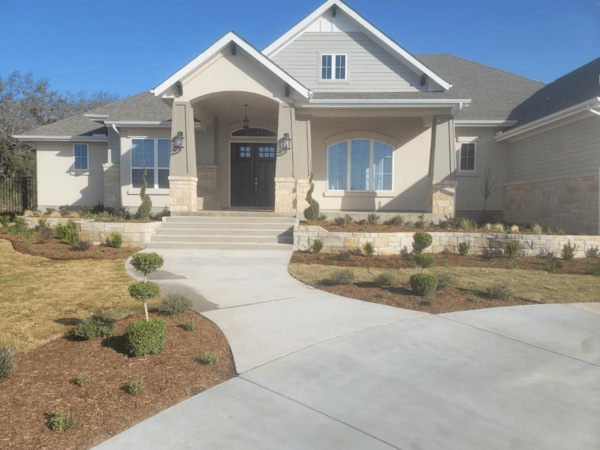
Grading and leveling happen in two stages. Rough grading is the heavy work: removing high spots, filling low areas, and cutting the overall slope to its target fall. Finish grading is the precision pass that smooths the surface to its final contour for sod, seed, or hardscape.
Cost depends on yard size, slope severity, clay and soil conditions, and how much fill dirt needs to be brought in or hauled off. Whether drainage work is included and how accessible your yard is to equipment also factor in. Each of those factors can shift the total significantly, and an on-site visit is the only way to produce a real number. Sprinkler & Landscape Medics provides a free on-site estimate with a written quote before the crew arrives.
No. Two yards on the same block can need completely different amounts of cut, fill, and drainage work based on slope, soil depth, and what is buried in the ground. A phone quote skips the three evaluations that actually determine cost: slope, soil, and drainage. If a contractor gives you a firm number without walking your property, that number is a guess. We visit every property before quoting.
Every grading project follows the same sequence, and one crew handles every phase.
Yes. We flag every irrigation component in the grading zone before equipment moves onto the site. Heads and valve boxes that sit in the path of the grade change are temporarily removed, and lines that cross the work area are rerouted or protected during excavati


