Walkway Installation in Austin, TX
Learn More About Our Complete Sprinkler Services



Sprinkler & Landscape Medics designs and installs custom walkways and garden paths as part of our Austin hardscaping services. We work with concrete, paver, flagstone, natural stone, and decomposed granite, and every path we build is graded to drain and based to last on local clay soil.
As a veteran-owned, NDS-certified drainage contractor and TCEQ-licensed irrigator, we handle grading, irrigation reroutes, and path lighting with one licensed crew. Call 512-710-7274 for a free estimate.


The material you choose affects how your walkway looks, how long it lasts, and what it costs. Here are the options we install across Austin:
For most Austin homes, we start the conversation with concrete or pavers and go from there based on budget and what the path needs to handle. Concrete takes heavy use and stays cooler than stone in direct sun.
Pavers come in more styles and colors and are easier to match to your home. For garden entries and backyard paths where natural texture is the priority, flagstone or Lueders limestone is the strongest choice.
A walkway is only as good as its grade. If the surface isn’t sloped to shed water, the path pools, erodes, and heaves on clay soil within a few seasons. Sprinkler & Landscape Medics is an NDS-certified drainage contractor, so every walkway we build starts with proper grading designed to move water off the surface and away from your foundation.
We also hold a TCEQ irrigation license (LI0025843), which means we can reroute sprinkler lines, valves, and heads that sit in the path’s route. You don’t need to hire a second contractor for that.
We are veteran-owned, founded by a U.S. Marine, and fully licensed and insured. Our team has served over 1,000 homes across Central Texas, and a portion of every service goes back into the community. We provide free estimates with written, upfront pricing for every walkway project.
Look for a contractor who compacts the base in layers, grades the surface for drainage, and handles the full scope without subcontracting. Sprinkler & Landscape Medics holds a 4.9-star Google rating with over 147 verified reviews.
Ask any contractor whether they do their own base prep, edging, jointing, and cleanup, or whether parts of the job get handed off to a crew they don’t manage.
We design and install walkways for every part of your property:
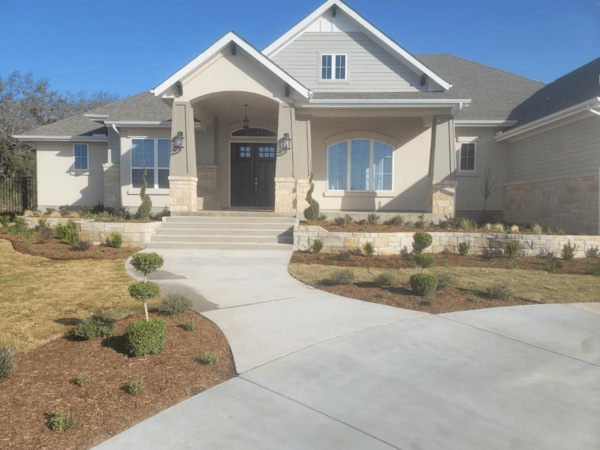
We build straight and curved layouts depending on your property’s shape and how you want foot traffic to flow. For yards with elevation changes, we add steps or terraced sections to keep the path safe and accessible.
Front yards call for wider, more durable paths that handle daily use and match the home’s exterior. Concrete, pavers, and brick work well here because they hold up to heavy traffic and give the entry a clean look.
Backyards are more flexible. Curved flagstone paths, decomposed granite trails, and stepping-stone layouts all work where you want the path to feel relaxed rather than formal.
Every walkway we install follows a seven-step process from design to final walkthrough.
We don’t use subcontractors on any walkway project, and we confirm your arrival window before we start.
Most residential walkway installations in Austin take two to five days. Straight concrete paths on flat ground finish fastest, while longer routes, curved layouts, and natural stone installations take more time.
Site prep on clay soil can also extend the timeline because the base needs deeper excavation and careful compaction. We confirm your installation window during the design consultation so you can plan around it.
On clay soil, water that sits on or near a walkway softens the base underneath and accelerates heaving, cracking, and edge failure. Proper slope and the right materials prevent all three.
For homeowners close to Austin’s 45% impervious cover cap, consider permeable pavers. These systems let rain pass through the surface and into the ground below rather than adding to your lot’s impervious total.
Under the City of Austin’s Drainage Criteria Manual, walkways where the pervious space between features exceeds 50% may be counted as pervious. That gives you more room for future projects like patios or pool decks.
We also build rain gardens and swales alongside paths to handle runoff on properties where clay holds water at the surface after storms. For properties with existing yard drainage systems, we make sure the new path works with your existing drainage, not against it.
Pooling and movement come down to slope, base, and edge restraints. We grade every path at a consistent slope so water moves off the surface before it can soak into the base below.
The crushed-stone base absorbs clay movement and keeps the walking surface level through wet and dry cycles. Edge restraints lock the perimeter so pavers and stone stay in position even as the surrounding soil shifts.


