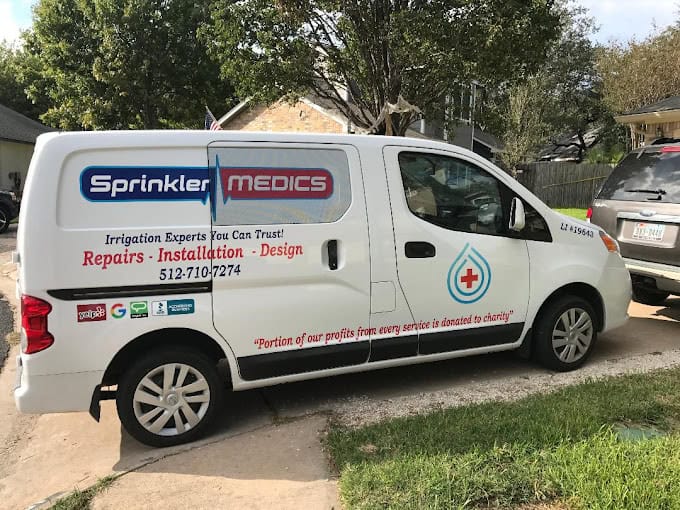
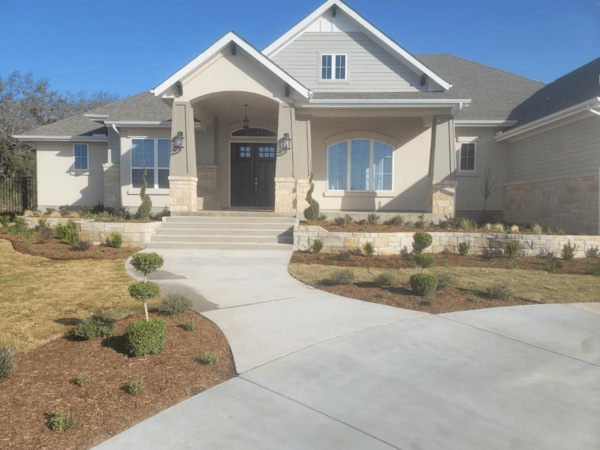
Sprinkler & Landscape Medics installs paver patios, driveways, walkways, and pool decks across Austin and Central Texas. Every surface we build sits on a properly compacted base with drainage engineered to handle Austin’s expansive clay soil.
We’re a veteran-owned, TCEQ-licensed, and NDS-certified drainage contractor, which means the same crew that lays your pavers also engineers the water management underneath them. Call 512-710-7274 for a free estimate with the scope in writing.
Why our client trusts Sprinkler & Landscape Medics
Custom Paver Installation Services in Austin, TX
Sprinkler & Landscape Medics builds paver surfaces for every part of your Austin property, from high-traffic driveways to backyard entertaining spaces. Here’s what we install as part of our landscape design and hardscaping services:
- Paver patios. Outdoor dining, entertaining, and lounging areas built on reinforced base for year-round use in Central Texas.
- Paver driveways. Heavier base sections designed to handle vehicle weight on clay soil, with patterns and colors that outperform plain concrete.
- Paver walkways and pathways. Front entry paths, side yard connections, and backyard routes linking your outdoor spaces.
- Retaining walls. Structural and decorative walls for grade changes, garden borders, and erosion control.
- Fire pit and outdoor living surrounds. Paver pads and borders for fire pits, outdoor kitchens, and seating areas integrated with your hardscape
Can You Install Pavers Around an Existing Pool, Fire Pit, or Outdoor Kitchen?
Yes. We install pavers around existing structures and tie them into what’s already in place. Pool decks, fire pit surrounds, and outdoor kitchen pads each require specific base prep, drainage, and edge detailing, and we protect existing plumbing, gas, and electrical runs during excavation.
Why Trust Sprinkler & Landscape Medics for Your Austin Paver Installation
Sprinkler & Landscape Medics is the only Austin paver contractor that also handles the drainage and irrigation beneath your surface. That combination keeps pavers level and stable in soil that moves.
- NDS-Certified Drainage Contractor. We design water management into the base and grading plan, not as an afterthought. Drainage is built into every paver project because it’s the single biggest factor in how long your surface holds up.
- TCEQ-Licensed Irrigator (License #LI0025843). Your sprinkler lines, valves, and wiring are located and protected before we dig. Other paver companies don’t carry this license and aren’t trained to work around irrigation systems.
- Veteran-Owned. Sprinkler & Landscape Medics was founded by a U.S. Marine. We show up when we say we will, price the job honestly, and don’t upsell. We maintain a 4.9-star Google rating across 147+ verified reviews from Central Texas homeowners.
- In-House Crew, Written Pricing. Over 1,000 homes served across greater Austin. Every estimate is written with line items visible before work begins.
Why Does Drainage Matter for Paver Installation?
Water is the primary reason paver surfaces fail in Austin. Without proper slope and drainage, rainwater saturates the soil beneath the base, and that soil loses its load-bearing strength. The pavers above settle, shift, or heave, and the only fix is a full tear-out.
Types of Pavers We Install for Austin Homes
We work with a full range of paver materials. What makes sense for your project depends on the look you’re going for, how the surface will be used, and what you want to spend.
- Concrete pavers. The most versatile and cost-effective option. Brands like Belgard and Pavestone offer a wide range of colors, shapes, and patterns. Durable in Austin’s heat and freeze-thaw cycles.
- Brick pavers. Classic look with color that runs all the way through, so it won’t fade under years of Texas sun.
- Natural stone and flagstone. Premium appearance with unique texture in every piece. Best suited for patios and walkways rather than driveways.
- Travertine pavers. Naturally cool underfoot, which matters in Austin summers. Limestone-based, so it fits Hill Country architecture. Requires periodic sealing.
- Porcelain pavers. Stain-resistant, low maintenance, and increasingly popular for modern outdoor spaces and pool decks.
- Permeable pavers. Designed to let water pass through the joints into a drainage layer beneath, which can reduce your property’s impervious cover.
What Type of Paver Is Best for Austin’s Climate and Soil?
For most Austin homeowners, concrete or brick pavers are the right call. They hold up well in the heat and clay, look good, and don’t break the budget. If heat underfoot is a priority near a pool, travertine is worth the premium. Talk to us about permeable pavers if your property is close to its impervious cover limit.
Our Austin Paver Installation Process: Built on Proper Base Prep and Drainage
Base preparation and drainage determine whether your paver surface lasts 20 years or sinks in two. Here’s how we build every project:
- Site evaluation and grading plan. We map your property’s slope, soil conditions, and existing irrigation layout. This data sets the excavation depth, drainage direction, and base design.
- Irrigation protection. Existing sprinkler system lines, valves, and wiring are located and protected or rerouted before any excavation begins.
- Excavation. We dig to ICPI-recommended depth: 4 to 6 inches of aggregate base for patios and walkways, 6 to 8 inches for driveways. Austin’s clay often requires the deeper end of that range.
- Sub-base and compaction. Crushed stone or road base is spread and compacted in lifts no thicker than 4 inches using a plate compactor.
- Drainage integration. Grading directs water away from the paver surface and your foundation. When slope alone isn’t enough, we tie in French drains or channel drains beneath or alongside the paver field.
- Bedding sand. A 1-inch layer of ASTM C33 concrete sand is screeded level over the compacted base as the setting bed.
- Paver laying and pattern. Pavers are placed in the selected pattern and cut to fit at edges and curves.
- Edge restraints, joint sand, and final compaction. Edge restraints are spiked into the compacted base to lock the paver field in place. We fill the joints with polymeric sand, and the surface gets a final pass with the plate compactor.
How Do You Keep a Paver Patio or Driveway From Sinking or Shifting in Austin?
By building a base deep enough and draining water away from it. Austin’s Blackland Prairie clay swells when it absorbs rain and shrinks during drought, and that cycle creates uneven pressure beneath any surface that sits on a shallow or uncompacted base. A deep, compacted aggregate base distributes that movement evenly so the pavers stay level. Drainage grading and, where needed, subsurface drains keep water from pooling under the base.
What Drives Paver Installation Cost in Austin?
Several factors move the total cost of a paver project. The biggest ones are material choice, project size, and how much excavation your soil requires. Drainage needs, demolition of existing concrete, pattern complexity, and site access also affect the number. Clay soil in Austin drives higher excavation and base-prep costs than areas with sandy or limestone soil because the base needs to be deeper and compaction takes more passes.
Demolishing and hauling away an existing slab before new pavers go down adds to the total, typically $2 to $6 per square foot depending on thickness.
How Much Does a Paver Patio Cost in Austin?
Most Austin paver patio installations cost between $8 and $25 per square foot. Concrete pavers start around $10 per square foot, and brick runs $12 to $20. At the premium end, natural stone and travertine range from $20 to $30. A 12×12 patio (144 square feet) typically falls between $1,400 and $2,500. A free on-site estimate is the most accurate way to price your specific project.
Paver Patios, Driveways and Walkways Built for Central Texas Conditions
Austin’s Blackland Prairie clay, drought-and-downpour swings, and occasional hard freezes all stress hardscape surfaces. Every one of those conditions acts on the soil beneath the pavers. The pavers are the surface you see; base prep and drainage are what keep it flat.
Proper base depth and compaction handle the shrink-swell cycle so the surface stays level through wet and dry seasons. Freeze events add another risk: water trapped in shallow joints or an undersized base can expand and push pavers out of alignment. Where projects sit adjacent to lawn or beds, we coordinate sod installation and grading so the finished landscape drains as one system.
Do I Need a Permit for a Paver Patio or Driveway in Austin?
Most paver patios that keep the property within i