
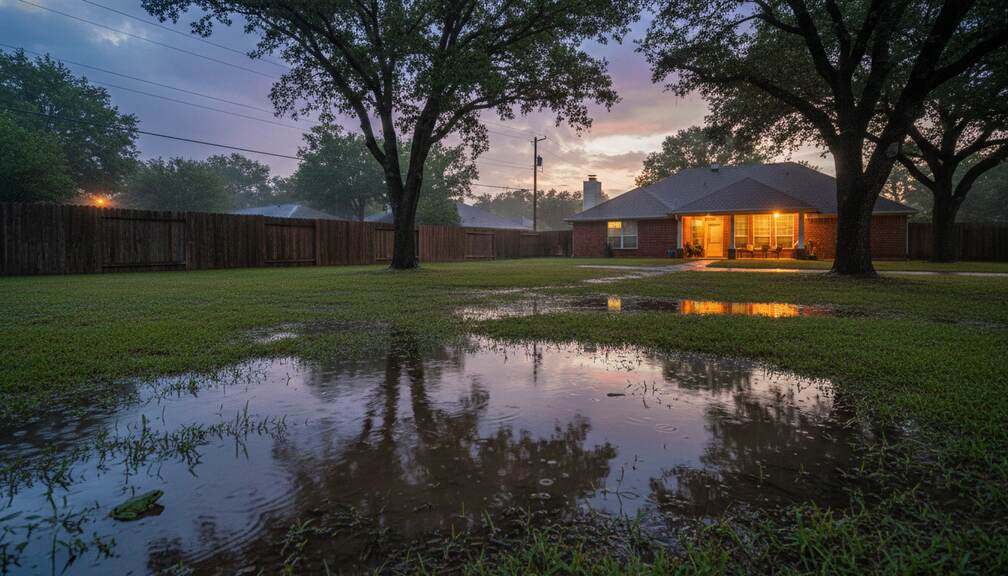
Three Common Drainage Problems in Austin Yards
Austin yards face three drainage problems more than any others: standing water caused by clay soil that cannot absorb rainfall fast enough, improper yard grading that directs water toward your foundation instead of away from it, and overwhelmed or disconnected gutter downspouts that dump concentrated roof runoff against your slab. The corresponding solutions are French drain installation to collect and redirect subsurface water, professional re-grading to restore proper slope away from your foundation, and downspout extensions with underground piping to carry roof runoff safely away from your home.
Why Drainage Problems Are So Common in Austin
Austin’s soil and substrate conditions make yard drainage failures predictable without proper design. Houston Black Clay covers most of East and South Austin, absorbing water so slowly that even moderate rainfall pools on the surface for days. Central Texas flash-flood rainfall patterns compound the problem — storms regularly deliver 2–4 inches of rain within a single hour, a volume that would overwhelm drainage systems built for more gradual rainfall even if the soil drained perfectly.
Clay swells when wet and shrinks when dry. That repeated expansion-and-contraction cycle prevents surface drainage and puts structural pressure against anything it surrounds, including your foundation. Saturated clay presses against your slab and exerts hydrostatic pressure, the force of trapped water pushing against a structure. Over time, that pressure causes cracking, settling, and heaving that no interior repair will permanently fix without addressing the drainage source.
In Westlake, Circle C, and Northwest Hills, rocky limestone substrate replaces clay as the primary problem. That substrate drains quickly on the surface but offers almost no depth for water to percolate downward, so runoff moves laterally and collects at every low point in your yard. Many older Austin homes predate consistent enforcement of modern drainage standards. FEMA data puts approximately $25,000 in damage per inch of floodwater entering a home, which puts a professional drainage assessment in perspective.
Why Sprinkler & Landscape Medics for Drainage Solutions in Austin
Fixing Austin drainage problems requires a contractor who understands both local soil conditions and how irrigation systems interact with drainage, and that is exactly what we do.
We are a veteran-owned, Marine-founded irrigation and landscaping company serving Central Texas. Our team is NDS-certified in drainage contracting. We’ve worked on more than 1,000 Austin-area properties, and our 4.9-star Google rating across 147+ reviews consistently points to professionalism and honest pricing. A portion of every service goes back into the Austin community. We offer seasonal membership plans for year-round irrigation and drainage monitoring. We serve Austin, Cedar Park, Round Rock, Georgetown, Pflugerville, Leander, Hutto, Liberty Hill, Manor, Taylor, and Jarrell.
What Does NDS-Certified Mean for Drainage Installation?
NDS (National Diversified Sales) is the largest U.S. manufacturer of drainage products, including French drains, channel drains, and catch basins. As NDS-certified contractors, we follow manufacturer-specified design and installation methods, meaning the system is built to documented performance standards rather than general contractor approximations. In Central Texas clay soils and flash-flood conditions, that precision is the difference between a drain that holds up and one that fails in its first heavy rain.
Problem One: Standing Water and Soggy Spots From Clay Soil
Houston Black Clay acts like a bathtub when saturated. The soil cannot absorb water at the rate Austin storms deliver it, and pooling persists for days after the rain stops.
Warning signs to watch for:
- Puddles that linger more than 24 hours after rain — your soil has already hit capacity
- Mushy or spongy areas in the lawn that squelch underfoot — the ground is saturated below the surface
- Grass dying in low spots — waterlogged roots cannot survive extended saturation
- Increasing mosquito activity near your home — standing water is an active breeding environment
If you ignore standing water, the consequences go well beyond a soggy lawn. Waterlogged turf kills your grass roots from the bottom up. One inch of standing water is all mosquitoes need to complete their breeding cycle. In an Austin summer, a yard that stays wet for 48 hours becomes a breeding ground within the week. Prolonged saturation causes root rot in your trees and shrubs, including drought-tolerant native oaks.
Solutions for standing water:
- French drain installation to collect and redirect subsurface water away from problem areas
- Soil amendment with organic matter to improve percolation in clay-heavy areas over time
- Dry well installation for properties where redirecting water to another part of the yard or off the property is not practical
Problem Two: Improper Yard Grading Directing Water Toward the Foundation
If the ground around your home slopes toward your foundation instead of away from it, you have a negative grading problem, and every rain event sends water straight toward your slab. IRC Section R401.3, Austin’s residential grading standard, requires at least 6 inches of drop within the first 10 feet of your foundation. Many older Austin homes predate consistent enforcement of that standard, and their yards still carry the original grading that directs rainfall straight toward the slab.
Warning signs of a grading problem:
- Water pooling against your foundation after rain — the slope is directing runoff toward your home rather than away from it
- Visible erosion along the slab line — water is moving along your foundation consistently
- Cracks appearing in brick or drywall at door and window corners — foundation movement is underway
- Doors that stick or will not close properly after heavy rains — your foundation is shifting under hydrostatic pressure
When the clay soil against your foundation becomes saturated repeatedly, it swells against your slab and builds hydrostatic pressure. That is the same mechanism that causes standing water damage, now focused directly on your foundation. That repeated pressure causes the foundation to crack, settle, and heave unevenly. Foundation repair in Austin typically costs $5,000 to $15,000 or more. Proper grading costs a fraction of that.
Solutions for grading problems:
- Professional re-grading to restore the slope required by the code requirement away from your foundation
- Channel drain installation along the foundation perimeter to intercept surface water before it reaches the slab
- Swale construction to redirect surface runoff across the yard and away from the structure
- Retaining walls for sloped properties, particularly relevant in Westlake and Northwest Austin where the terrain creates natural negative-grade conditions
- Full landscaping and re-grading services are available through Sprinkler & Landscape Medics for properties that need comprehensive correction
Problem Three: Overwhelmed or Disconnected Gutter Downspouts
Your downspouts may be the source of the problem even if your gutters are clean and fully functional. A 2,000-square-foot roof sheds over 1,200 gallons during a single 1-inch rainfall, all of it exiting through your downspouts. Where that water goes from there determines whether your foundation stays dry or takes the hit.
Warning signs of a downspout problem:
- Visible erosion or soil washout under gutter lines after rain — your downspouts are discharging more water than the soil can absorb at that point
- Water stains on your foundation at downspout discharge points — concentrated runoff is reaching your slab consistently
- Mulch washing away from beds near the house — discharge force is too high and too close to the structure
- Basement or crawl space moisture following heavy rain — subsurface water is reaching below-grade areas
Fall is the hardest season for your gutters in Austin. Live oaks and pecans shed heavily in October and November, and gutters that were clear in September can be fully blocked by the first significant fall rain. That blockage sends roof runoff straight over the gutter edge and down against your foundation.
Solutions for downspout drainage failures:
- Downspout extensions of 5 to 10 feet minimum from the foundation as a baseline correction
- Underground piping to emitters positioned in the lawn away from the foundation for long-term reliability
- Connection to an existing French drain system for comprehensive coverage across the drainage zone
- Rain barrel or cistern collection, which some Austin neighborhoods require as part of their stormwater management approach
When to Call a Drainage Professional in Austin
Some drainage problems are DIY territory. These are not.
Red flags that require professional assessment:
- Water reaching within 6 inches of your foundation after rain — you are one heavy storm away from structural contact
- New or widening cracks in the foundation, brick, or drywall — movement is already underway
- Water entering your home through the slab or walls — the drainage failure has breached your structure
- Soggy areas persisting more than 48 hours after rain stops — your soil is no longer recovering between events
- Your neighbor’s runoff draining onto your property — the source is outside your yard and requires professional evaluation
Ready for reliable drainage service from a veteran-owned team you can trust? Call Sprinkler & Landscape Medics of Austin today at 512-710-7274 or reach out online to schedule your free consultation.



Leave a Reply
Want to join the discussion?Feel free to contribute!