
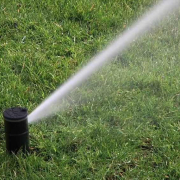
rotary vs spray sprinkler heads

Rotary vs Spray Sprinkler Heads: Which Is Better for Your Lawn

Choosing the wrong sprinkler head for your yard means brown spots that don’t respond to longer run times, runoff pooling at the curb before your cycle finishes, and water wasted on the one day per week Austin Water allows you to run your system. The head type determines how fast water hits the ground, how far it reaches, and whether your soil can actually absorb it before it runs off.

In Central Texas, that last point matters more than most homeowners realize. Austin’s clay-heavy soil absorbs water at roughly 0.2 to 0.5 inches per hour. Spray heads apply water at 1.5 to 2 inches per hour. Rotary nozzles apply water at 0.4 inches per hour. Those numbers explain why two systems with identical run times produce completely different results depending on what’s sitting on top of the pop-up body.

Spray heads, rotors, and rotary nozzles each serve different zone sizes, soil conditions, and coverage needs. The table below shows how they compare across the factors that matter most for Austin lawns.

  Spray Head Rotor Rotary Nozzle
Best-Use Area Small, defined turf, bed edges Large open turf zones Mid-size turf, slopes, clay soil zones
Typical Radius 5–15 ft 25–65 ft 8–35 ft
Precipitation Rate (in/hr) 1.5–2 in/hr 0.4–0.8 in/hr 0.4 in/hr
Run Time vs. Spray Baseline 2–3x longer 2–2.5x longer
Runoff Risk Higher on clay or slopes Lower Lowest
Misting in Wind Common at high pressure Less common Low
Austin Suitability Note Small lots, bed edges, patios Large turf, suburban lots Clay soil, slopes, retrofit zones
Common Application in Austin Narrow front strips, planting bed edges Open back yards, large side yards Runoff-prone clay zones, sloped turf

What Are Spray Heads, Rotors, and Rotary Nozzles?

All three head types work on different principles, cover different areas, and suit different yard conditions. Here is what each one actually does.

What Is a Spray Sprinkler Head and Where Does It Work Best?

A spray sprinkler head delivers a fixed, fan-shaped spray pattern that does not rotate, covering areas from roughly 5 to 15 feet in radius depending on the nozzle installed. The nozzle is interchangeable, which means the same pop-up body can accept different coverage arcs, and spray heads apply water at 1.5 to 2 inches per hour — a rate that gets moisture to the root zone fast and keeps your run times short.

Spray heads perform best at 25 to 30 PSI. Above that range, the spray pattern mists rather than throws, reducing coverage and wasting water. Most spray heads use a pop-up body that retracts below grade when not running, though shrub risers are available for raised-bed applications where pop-up height is not sufficient.

If your zone is small, Austin Water’s one-day-per-week schedule works in your favor. Higher application rates mean spray zones reach their target moisture depth faster, which suits restricted watering windows when the irrigated area is small and the water has somewhere to go without running off.

What Is a Rotor Head, and How Is It Different From a Rotary Nozzle?

A gear-driven rotor uses an internal turbine mechanism to rotate a single stream of water back and forth across a wide arc, covering 25 to 65 feet in radius at a precipitation rate of 0.4 to 0.8 inches per hour. Rotors run at 25 to 65 PSI depending on the model, and because the application rate is lower, your rotor zones will need significantly longer run times than spray zones to deliver the same soil moisture depth.

A rotary nozzle is a different product — a multi-stream nozzle insert that mounts on a standard spray body rather than a standalone head. Instead of a single rotating stream, it delivers multiple slow-moving streams that rotate outward from the nozzle, covering 8 to 35 feet at a standard precipitation rate of 0.4 inches per hour. The Hunter MP Rotator is the most widely installed example. The rotor is a standalone head with its own body, drive mechanism, and installation footprint; the rotary nozzle is an insert that drops into the same spray body you already have. If you have an existing spray system, that distinction matters — a rotary nozzle upgrade means no trenching, no pipe work, just a nozzle swap on each head.

Key Differences That Affect Coverage, Runoff, and Run Times

Run time, runoff, and distribution uniformity determine whether your irrigation system waters your lawn or wastes water. In Austin, clay soil absorbs water slowly and summer heat punishes dry zones within days. These variables matter more here than in most other markets — and they should drive how you set up your system.

Why Do Spray Heads Usually Need Shorter Run Times Than Rotors?

Spray heads apply water faster, so they need less time to deliver the same moisture depth to the root zone.

Your spray zones may need 10 to 15 minutes per cycle; your rotor and rotary nozzle zones may need 25 to 40 minutes to deliver the same moisture depth. That ratio holds across most yards, though actual run times vary by plant type, season, and how much water your soil can absorb before runoff begins. Austin Water publishes seasonal watering guidelines at austinwater.org organized by season and plant category — the most locally relevant reference for setting or adjusting your controller.

How Do Precipitation Rates Change Runoff Risk on Slopes or Compacted Soil?

Spray heads apply water faster than your clay soil can absorb it. The excess runs off instead of soaking in. Central Texas clay soil absorbs roughly 0.2 to 0.5 inches per hour under normal conditions. Spray heads apply 1.5 to 2 inches per hour.

The fix is cycle-and-soak programming. Instead of running a zone once for 30 minutes straight, split that into two 15-minute cycles with a 30-minute gap between them. The first cycle wets the soil surface; the gap gives the clay time to absorb that water before the second cycle adds more. This works for spray zones, rotor zones, and any zone on a slope or in an area that shows pooling before the run cycle ends.

Runoff is also a TCEQ compliance issue, not just a water bill problem. Texas Administrative Code Chapter 344 prohibits irrigation water from flowing onto driveways, sidewalks, and streets — and that runoff may put you out of compliance with your system.

What Is Distribution Uniformity and Why Does It Matter for Brown Spots?

Distribution uniformity (DU) measures how evenly water reaches each part of a zone. A low-DU zone delivers too much water in some spots and too little in others — even when your run times look right and the system appears to be working.

Low DU is one of the most common causes of dry patches in Austin irrigation systems. It is frequently misdiagnosed as a run time problem. If you try to fix dry spots by running the zone longer, you end up overwatering the saturated areas while the dry patches barely improve. The cause is usually head spacing, nozzle mismatch, or pressure inconsistency — not run time.

Austin’s summer heat, with triple-digit temperatures common from June through September, makes low-DU zones visually apparent within a single heat wave. Sprinkler Medics can identify whether the cause is spacing, pressure, or head type before you spend money replacing heads that weren’t the problem.

How to Choose the Right Head Type for Your Yard

The right head type depends on what your yard is actually asking of the system — zone size, soil behavior, and slope all point toward different answers. Start with the size of the area you need to cover.

Which Sprinkler Head Is a Better Fit for Small or Irregular Lawn Areas?

If your zone is under 15 feet in any dimension, spray heads are your standard choice. The fixed fan-shaped pattern covers those areas precisely, the shorter run time suits tight scheduling windows, and the interchangeable nozzle format lets your installer match the coverage shape to your lot.

For narrow side-yard runs, strips between concrete and planting beds, or zones that run along a fence line, strip nozzles are the right tool. Strip nozzles deliver a narrow rectangular pattern instead of a radial fan — common on Austin bungalow and ranch-style lots where a standard nozzle would hit hardscape on both sides.

Small areas near patios, walkways, or driveways benefit from spray heads for another reason: faster application can be timed to finish before runoff reaches the surface.

Which Sprinkler Head Is a Better Fit for Larger Turf Zones?

If your turf zone exceeds 30 feet in any dimension, rotors are your standard choice. The wider throw radius means fewer heads cover the same area, the lower precipitation rate reduces runoff risk on larger expanses of clay soil, and the longer run time trades against fewer valves and less pipe to maintain.

Fewer heads and valves has a direct cost implication for new installs. To cover a 5,000 square foot back yard with spray heads, you need significantly more heads, valves, and pipe than you would with rotors. On larger lots, that difference shows up meaningfully in the installation estimate.

Newer suburban developments in Round Rock, Cedar Park, Georgetown, and Pflugerville commonly feature larger open turf areas where rotors are the right choice from the start. Many older systems in those areas were installed with spray heads that should be rotor zones — converting them is often more cost-effective than maintaining a spray system undersized for the space.

Do Rotary Nozzles Help Reduce Runoff in Clay Soil?

Rotary nozzles, specifically multi-stream nozzles like the MP Rotator, apply water at 0.4 inches per hour, which falls within the typical infiltration capacity of Central Texas clay soil. That match largely eliminates the runoff problem without requiring cycle-and-soak programming, and it does so using the same spray body already in the ground.

The rotary nozzle insert drops directly onto any standard spray body — no trenching, no pipe work, no valve changes. Swap the nozzle, adjust the run time upward, and your zone performance changes immediately.

Austin’s hard-water supply adds one maintenance requirement specific to this area. Check and clean the inlet filter on your rotary nozzles at least once per season. Hard-water deposits build up in the filter over time, cutting flow and shrinking your coverage radius. In zones with heavier mineral deposits, replace the filter annually.

Design Rules Pros Use to Avoid Dry Spots and Water Waste

The technical principles behind head selection only produce results when the installation follows the design rules that govern how heads are zoned, spaced, and programmed. In Texas, TCEQ-licensed irrigators are required to meet specific design standards on every installation.

Can You Mix Spray Heads and Rotors in the Same Zone?

Mixing spray heads and rotors in the same zone violates matched precipitation rate requirements. Texas irrigation law prohibits it.

When spray heads and rotors share a zone, the spray head area receives 1.5 to 2 inches per hour while the rotor area receives 0.4 to 0.8 inches per hour during the same run cycle. To deliver adequate water to the rotor area, you run the zone long enough for the rotor to cover its territory — but by that point the spray head area has received two to four times its appropriate application. The result is runoff in one section and dry spots in another. No run time adjustment fixes both.

Every Sprinkler Medics installation is designed to matched precipitation rate standards under Chapter 344. A properly permitted job will never mix spray heads and rotors on the same zone. If a zone behaves inconsistently no matter how you adjust run times, check for mixed head types first.

What Is “Matched Precipitation Rate” and Why Does Texas Require It?

Matched precipitation rate means all heads in a zone apply water at the same depth per hour, regardless of the arc size or spacing of each individual head. A head covering a 90-degree arc and a head covering a 180-degree arc will not automatically apply water at the same rate just because they are the same model.

Mismatched rates mean some areas get too much water and others too little in the same run cycle. A 90-degree nozzle and a 180-degree nozzle apply water at different rates unless the nozzle is specifically chosen to compensate for the arc. Most standard spray nozzles do not do this automatically. That mismatch produces exactly the kind of brown spots and wet spots you would typically blame on run time rather than design.

Texas Administrative Code Chapter 344 requires matched precipitation rate on all residential irrigation installations. TCEQ uses this standard to evaluate licensed irrigator compliance on every installation.

What Does “Head-to-Head Coverage” Mean in Plain English?

Head-to-head coverage means each head’s spray pattern reaches the base of the next head in every direction, so every point in your zone gets water from at least two heads.

Without head-to-head coverage, the outer edges of each head’s radius receive only a fraction of the water applied closer to the head. The middle of each head’s pattern gets full coverage; the edges between heads get partial coverage from both sides — and the result is a ring of dry turf that persists no matter how long the zone runs. Homeowners who add run time to fix dry edges end up overwatering the center of each head’s pattern. The dry rings stay.

Improper head spacing is one of the most common problems Sprinkler Medics finds on Austin system inspections, particularly in systems installed before TCEQ codified current spacing standards. If your yard has a repeating pattern of dry spots that appear roughly equidistant from each other and from the heads around them, head spacing is the likely cause.

FAQs About Rotary vs Spray Heads for Austin Lawns

How Long Should I Run Spray Heads vs Rotors in Austin?

Plan on 10 to 15 minutes per cycle for spray zones and 25 to 40 minutes for rotor and rotary nozzle zones. The difference traces directly to precipitation rate. Neither figure is fixed — season, plant type, and soil condition all shift the numbers.

Austin Water’s seasonal watering guidelines at austinwater.org are your most reliable local starting point for setting or adjusting your controller run times.

For clay soil zones showing pooling before the run cycle ends, split your rotor run time into two shorter cycles with a 30-minute gap between them.

If your spray heads show runoff or misting, upgrading to rotary nozzles is often the most practical fix.

Are Multi-Stream Rotary Nozzles a Good Upgrade From Traditional Sprays?

Rotary nozzle upgrades are a practical option for Austin spray zones showing runoff, dry spots, or pressure misting — the nozzle fits directly onto your existing spray body without any pipe work. Pull the old spray nozzle off the pop-up, thread the rotary nozzle on, and your zone goes from applying 1.5 to 2 inches per hour down to 0.4. For zones on clay soil or slight slopes, that rate change alone often eliminates the runoff problem.

After upgrading to rotary nozzles, increase your controller run times by approximately 2 to 2.5 times to deliver the same soil moisture depth. If your spray zone ran for 12 minutes, plan on 25 to 30 minutes after the rotary nozzle swap. Skipping that adjustment is the most common mistake after a rotary nozzle upgrade and leaves turf under-watered.

Before You Switch Heads

  • Check static water pressure at the valve box. Rotary nozzles perform well at 40 PSI; spray heads operate at 25 to 30 PSI. If pressure falls significantly outside these ranges, a pressure regulator may be needed before switching.
  • Confirm that existing head spacing matches the coverage radius of the new nozzle type. Rotary nozzles have a wider radius than most spray heads, and spacing that worked for spray heads may leave gaps with rotary nozzles.
  • Identify zone type. Rotary nozzles can share a zone with other rotary nozzles but cannot be mixed with standard sprays or rotors in the same zone without violating matched precipitation rate requirements.
  • Locate the inlet filter slot on the new rotary nozzle and confirm a fine-mesh filter is included. Austin’s hard-water supply requires a functional filter to prevent mineral buildup in the nozzle mechanism.

Get the Right Heads on Your Austin Irrigation System

Choosing between spray heads, rotors, and rotary nozzles comes down to zone size, soil behavior, and slope. In Central Texas, where clay soil absorbs water slowly and Austin Water gives you one assigned day per week to work with, the wrong head type on the wrong zone costs you that entire window every time your system runs.

If your yard has persistent dry spots, runoff pooling at the curb, or zones that mist instead of throw, the problem is more likely head selection or spacing than run time. Adding minutes to a poorly matched zone does not fix the underlying issue.

Sprinkler Medics of Austin is a TCEQ-licensed, veteran-owned irrigation company serving Greater Austin, Cedar Park, Round Rock, Georgetown, Pflugerville, and the surrounding area. Ready for reliable irrigation service from a veteran-owned team you can trust? Reach out to Sprinkler Medics of Austin today for a free estimate.
choose a sprinkler company Austin

How to Choose the Right Sprinkler Company for Your Austin Property

Hiring the wrong sprinkler company in Austin costs more than a bad experience. It can mean a system that wastes your entire weekly watering window, fails a TCEQ inspection, or puts your drinking water at risk from incorrectly installed backflow prevention. Getting it right starts before you ever compare prices or read a single review.

In Texas, irrigation installation is regulated work. A licensed irrigator carries TCEQ credentials and operates under minimum design and installation standards set by state law. Any contractor who cannot provide a current TCEQ license number before the job starts is not legally permitted to do the work, regardless of how good their reviews look.

At Sprinkler Medics of Austin, we are a licensed, insured, veteran-owned team serving Greater Austin, Cedar Park, Round Rock, Georgetown, Pflugerville, and the surrounding area. We offer free estimates and put every scope in writing before any work begins. This guide walks you through how to verify credentials, what a complete estimate should include, and what to watch for when comparing companies so you can hire with confidence.

Start With the Basics: Licenses, Insurance, and Local Experience in Austin

Before you compare reviews, estimates, or design approaches, confirm that the contractor is legally permitted to do the work. Confirming credentials rules out unqualified contractors before anything else.

How Do I Verify a Texas Irrigation License Before Hiring?

Texas law requires anyone who installs, repairs, designs, maintains, or inspects an irrigation system to hold a current TCEQ license. The licensed irrigator (LI) credential is the primary installation-level license; irrigation technicians working on a job must be supervised by a licensed irrigator. Confirm a contractor’s TCEQ license status using TCEQ’s online license verification resources — search by name or license number and confirm the license is current, active, and matches the credential level appropriate for the scope of work. If a technician arrives without the licensed irrigator on-site, ask who holds the LI credential and will be supervising the job, because a technician operating independently without a supervising LI is not in compliance with Texas irrigation law.

What Insurance Should a Sprinkler Company Carry in Texas?

A qualified irrigation contractor carries two types of insurance: general liability, which covers property damage that may occur during the job, and workers’ compensation, which covers injuries to crew members working on your property. Irrigation work in Austin typically involves trenching through established turf, connecting at the water meter, and working around existing landscaping, so general liability coverage is a meaningful protection, not a checkbox formality. Request a certificate of insurance before approving any work; a contractor who cannot produce one is not operating with the coverage you should expect.

Confirm these five items before moving to reviews or estimates:

  • TCEQ license status: Confirm the contractor’s license is current and active using TCEQ’s online license verification resources; ask for the license number before scheduling a visit
  • Credential level: Confirm whether the license is a licensed irrigator (LI) or an irrigation technician operating under a supervising LI; ask who holds the LI license and who will be on-site
  • Proof of general liability insurance: Request a certificate of insurance before work begins
  • Proof of workers’ compensation: Confirm the contractor carries workers’ compensation coverage for crew members working on your property
  • Service area and local experience: Confirm the company regularly serves Austin-area properties and is familiar with Central Texas soil conditions, lot layouts, and Austin Water’s watering-day schedule requirements

Reviews, References, and Real Work Examples: What to Look For

Most people look at the star average and read the most recent few comments. The more useful approach is to look for consistent patterns across a larger sample: what problems did the company face on the job, and how did they handle them?

What Should I Look for in Google Reviews for an Austin Sprinkler Company?

A single glowing review or a single complaint tells you very little. Look instead for patterns across ten or more reviews — do multiple customers mention that the technician tested every zone before leaving, that the final price matched the quote, or that the same problem did not return after the repair? Repeated mentions of return visits for the same issue, surprise charges after the job, or technicians who left without a walkthrough are more meaningful than a one-star outlier, because those patterns indicate how the company handles the gap between what was promised and what actually happened. Reviews that mention Central Texas conditions specifically — clay soil, sloped lots, Austin Water watering-day scheduling, or work in Austin neighborhoods and suburbs — indicate that the company is genuinely familiar with this market, not just operating in it.

Should I Ask for Photos, Addresses, or Before-and-After Examples?

Photos of completed work and before-and-after documentation give you something reviews cannot: visual confirmation of how the company handles turf restoration after trenching, how cleanly valves and heads are installed, and what a repaired zone looks like at completion. Ask for examples on properties with conditions similar to yours — in Austin, that means yards with Central Texas clay soil, sloped areas that required runoff management, or mixed layouts where turf zones and bed drip zones needed to be designed separately. A company that has done this work repeatedly will have examples without hesitation.

If a company offers to connect you with past customers, use these questions:

  • Was the final invoice close to the original quote? A final invoice that matches the quote is one of the clearest signs of honest communication
  • Did they explain options before starting work? A qualified company diagnoses first and recommends second; they should not begin work before you understand what is being done and why
  • Did they test every zone at the end of the visit? A company that skips the final walkthrough is leaving coverage verification to you
  • Did the repair or installation hold without a return visit for the same problem? A repair that fails again points to a missed diagnosis, not just a bad part
  • Did the technician explain what they found and what they did? Clear communication after the job — parts replaced, zones adjusted, controller reprogrammed — is part of professional service, not an extra

Estimates and Scope: How to Compare Quotes Without Guessing

A price comparison between two estimates only means something if both estimates cover the same work. A quote that omits restoration, skips the final testing walkthrough, or does not specify the backflow prevention device is a shorter scope that will produce either additional charges later or incomplete work.

What Should a Sprinkler Repair or Installation Estimate Include?

A complete irrigation estimate names the number of zones affected, lists specific parts by type including heads, nozzles, valves, and controller, covers labor, includes a restoration plan for any trenching through turf or hardscape, specifies the backflow prevention device per TCEQ requirements and the City of Austin’s backflow prevention program, and includes a pressure test and a final zone-by-zone testing walkthrough. For Austin properties, the estimate should also confirm controller programming to your assigned Austin Water watering day, because these are not optional line items for a licensed irrigator working in this market. A contractor who maps zones and runs a coverage test before finalizing recommendations is diagnosing the system rather than estimating parts — recurring problems in Austin irrigation systems are frequently caused by design or coverage issues that part replacement alone does not fix.

Before treating two estimates as comparable on price, confirm each covers the same line items:

  • Zones affected: The estimate names specific zones by number, not just “affected areas”
  • Parts specified by type: Heads, nozzles, valves, and controller are listed individually, not summarized as “parts and materials”
  • Labor included: Labor is a separate line item, not bundled into a total without breakdown
  • Restoration plan: The estimate describes how turf, mulch, or hardscape disturbed during trenching will be restored
  • Backflow prevention device: The device type is named and specified per TCEQ requirements and the City of Austin’s backflow prevention program
  • Controller programming: The estimate confirms the controller will be programmed to your assigned Austin Water watering day
  • Pressure test: A mainline and lateral pressure test before backfill is included in the scope
  • Final testing walkthrough: A zone-by-zone coverage confirmation at completion is included
  • Warranty terms stated: Warranty coverage for parts and workmanship is written into the estimate

What Questions Should I Ask Before I Approve the Work?

Before approving any repair or installation scope, you should be able to get clear, direct answers to the following questions. A contractor who is reluctant to answer any of them is giving you useful information about how the job will be managed.

  • What is your TCEQ license number, and can I verify it? Confirming the license is current and active through TCEQ’s online resources is the first step before any other evaluation
  • What does the written estimate include — parts, labor, restoration, programming, and the final testing walkthrough? Get every component documented in writing before approving
  • Will you map zones and test coverage before finalizing your recommendations? A good contractor diagnoses the system before recommending parts — not the other way around
  • What backflow prevention device is included, and does it meet TCEQ and City of Austin requirements? Confirm the device type is appropriate for the system configuration
  • Will the controller be programmed to my assigned Austin Water watering day? Confirm this is part of the scope
  • What are the warranty terms for parts and workmanship, and are they in writing? A contractor who stands behind their work puts warranty terms in writing
  • How will you restore the lawn or hardscape after trenching? Confirm the plan before work begins

If any of the following come up during the estimate conversation, pause before proceeding:

  • Verbal-only scope with no written estimate: A contractor unwilling to document what they are proposing has no accountability for what gets delivered
  • No TCEQ license number provided when asked: A contractor who cannot or will not provide a license number is either unlicensed or operating outside TCEQ compliance
  • Vague parts description such as “parts and materials” with no specifics: An estimate that does not name head types, valve brands, or controller model cannot be compared to another estimate on the same basis
  • No mention of a final testing walkthrough: Completing the job without zone-by-zone coverage confirmation leaves you with no verification that the work was done correctly
  • Pressure to approve without a written scope: Pressure to approve before a written scope is ready is a red flag, not a scheduling issue
  • Unclear or absent warranty: A contractor confident in their workmanship puts warranty terms in writing without being asked
  • No answer to the backflow prevention question: Inability to name the correct device type indicates unfamiliarity with TCEQ requirements and the City of Austin’s backflow prevention program

Quality and Water Efficiency: Design Choices That Matter in Central Texas

Water-efficient design is the minimum standard licensed irrigators in Texas are required to meet under Texas Administrative Code Chapter 344. Austin Water’s conservation requirements reinforce those expectations at the local level. A company that designs around overspray, mismatched head types, or unregulated pressure is not meeting the standard for this market.

How Can I Tell If a Company Designs for Efficiency Instead of Overwatering?

A company designing for efficiency will not have heads spraying pavement or hardscape, will match head types within each zone so precipitation rates are consistent, will regulate pressure where the supply line exceeds manufacturer specifications, and will use drip zones for foundation beds and plantings where spray heads would produce overspray. These are standard practice for any licensed irrigator, not add-ons.

Central Texas clay soil absorbs water significantly more slowly than sandy or loam soils, so a system that applies water faster than the soil can infiltrate produces runoff rather than root-zone absorption. In Austin, where automatic irrigation is restricted to one assigned watering day per week, that wasted water cannot be recovered by running the system again. Cycle-and-soak scheduling combined with matched head types are the professional design responses to this condition, an approach supported by Texas A&M AgriLife Extension guidance on Central Texas soil behavior and water-efficient irrigation design.

When you ask a company how they handle zones with mixed plant types or sloped areas prone to runoff, a company familiar with Austin conditions will describe specific design choices without prompting. A company that describes a one-size-fits-all approach to zone layout is not accounting for the site conditions that determine whether the system performs correctly.

Do Austin Inspections or Guidelines Affect How Systems Should Be Installed?

Austin Water offers irrigation system check-ups and publishes residential irrigation inspection information that defines local expectations for system performance, water efficiency, and backflow prevention compliance. A qualified contractor’s installation and design choices should align with what Austin Water evaluates during a check-up.

TCEQ’s final inspection checklist covers zone mapping, backflow prevention device type and placement, pressure test results, and confirmation that the controller is programmed to the applicable watering schedule. Austin Water defines what a thorough inspection covers at the local level, and together these two frameworks set the standard for what a compliant, water-efficient Austin irrigation system looks like at completion.

When a company describes their completion process, listen for whether it matches these benchmarks: zone-by-zone coverage confirmation, backflow device documentation, pressure test completion, and controller programming to the assigned watering day.

If your system is already showing problems, use this table to connect what you are seeing to what it typically indicates and what a qualified company should do next:

What You’re Seeing What It Often Indicates What a Qualified Company Does Next
Dry spots that persist through the watering season Inadequate head-to-head coverage, blocked or misaligned heads, or zone design gaps Runs each zone, maps coverage, identifies underperforming heads or spacing problems before recommending parts
Runoff pooling at the curb or sidewalk during cycles Precipitation rate exceeds the soil’s infiltration capacity, or heads are spraying hardscape Evaluates head type and precipitation rate per zone, checks for hardscape overspray, and adjusts scheduling to cycle-and-soak
Misting or fogging instead of a clean spray arc Water pressure exceeds the head manufacturer’s specifications for that nozzle type Measures static and dynamic pressure at the source, identifies which zones need pressure regulation
Soggy area around the valve box between cycles Underground leak at the valve or mainline, or valve not closing completely Performs a pressure test on the mainline and lateral lines to locate the leak source before opening the ground
One or more zones not turning on Electrical fault at the controller, solenoid failure, or wiring break between the controller and the valve Tests the controller output and valve solenoid resistance before recommending controller or valve replacement

FAQs About Choosing a Sprinkler Company in Austin

Should I Hire a Company That Only Does Repairs, or One That Also Installs Systems?

A company that performs both repairs and installations can evaluate the overall condition of your system during a repair visit rather than diagnosing each failure as an isolated problem. Recurring leaks, persistent dry spots, or zones that repeatedly fail are often signs that the system design itself needs evaluation, which a repair-only contractor may not be equipped to assess.

Systems installed in Austin before the current watering-day restriction framework was in place may have controller programming or zone design that does not align with your current allowed schedule, and a company with installation experience can identify these misalignments during a repair visit.

For a single broken head or a zone that stopped responding, a repair-specialist company is typically sufficient. For a system with a history of recurring problems, coverage gaps across multiple zones, or a controller that predates Austin Water’s current schedule requirements, a company that also designs and installs systems can provide a more complete evaluation.

How Often Should I Schedule an Irrigation Check-Up in Austin?

For Austin residential irrigation systems, an annual check-up is the standard professional baseline, with timing set before the high-use summer season begins. Properties with older systems, a history of recurring repairs, or systems that have not been professionally evaluated in more than two years benefit from a mid-season inspection as well. A professional irrigation check-up in Austin typically includes zone-by-zone coverage evaluation, pressure testing, controller adjustment to the current Austin Water watering schedule and any active drought stage restrictions, and identification of worn heads, valve issues, or backflow device conditions before they become failures. Central Texas summer heat, clay soil compaction over time, and the periodic drought conditions that trigger Austin Water conservation stage escalations make annual zone evaluation more consequential here than in regions with more forgiving soil and climate conditions. A system that performs correctly in April may develop pressure, coverage, or scheduling issues by July without a mid-season check.

Get a Free Estimate From a Licensed Austin Sprinkler Company

The right sprinkler company in Austin provides a current TCEQ license number before the job starts, puts the full scope in writing before any work begins, and programs your controller to your assigned Austin Water watering day as a standard part of the job. Those are not extras to negotiate for. They are the baseline for licensed irrigation work in Texas.

If a contractor cannot meet that baseline, the problems show up in your yard and on your water bill long after they have left.

Sprinkler Medics of Austin is a TCEQ-licensed, insured, veteran-owned irrigation company serving Greater Austin, Cedar Park, Round Rock, Georgetown, Pflugerville, and the surrounding area. We offer free estimates, written scopes, and a final zone-by-zone walkthrough on every job. Ready for reliable irrigation service from a veteran-owned team you can trust? Reach out to Sprinkler Medics of Austin today for a free estimate.

professional sprinkler installation

Benefits of Professional Sprinkler Installation for Austin Lawns

A sprinkler system is only as good as the installation behind it. In Austin, where watering is restricted to one assigned day per week and the soil runs clay-heavy across most of the metro, a poorly designed system wastes your entire weekly watering window and leaves you with a lawn that never quite recovers.

Professional sprinkler installation in Austin goes well beyond digging trenches and connecting heads. A licensed irrigator designs your system around your specific yard, accounting for soil type, sun exposure, water pressure, and Austin Water’s scheduling rules, so every zone applies water where it’s needed at a rate the ground can actually absorb.

At Sprinkler Medics of Austin, our veteran-owned team has installed and repaired irrigation systems across Greater Austin, Cedar Park, Round Rock, Georgetown, and the surrounding area. We know the soil conditions, the caliche layers, and the watering rules that catch DIY installs off guard. This guide covers what professional installation includes, why it matters for Central Texas lawns, and what to ask before any contractor breaks ground on your property.

Why Professional Sprinkler Installation Matters in Austin, Texas

Austin-area soils are predominantly clay-heavy, which means they absorb water significantly more slowly than sandy or loam soils. A system that applies water faster than the soil can infiltrate it produces runoff rather than root-zone absorption. Caliche rock layers complicate trenching depth in many Central Texas neighborhoods. Sun exposure varies significantly between front yard turf, shaded side yards, and foundation beds, each requiring different head types and run times. Austin’s periodic drought conditions make head selection and precipitation rate accuracy more consequential than in less restricted areas.

Your installer accounts for these conditions through site-specific zone design, head type selection matched to each area’s infiltration rate and plant type, and cycle-and-soak scheduling that works within Austin Water’s assigned watering window. Texas A&M AgriLife Extension supports this approach in its guidance on Central Texas soil behavior and watering efficiency.

What Does “Professional Sprinkler Installation” Include Compared to DIY?

A professional installation includes:

  • Site-specific system design
  • Zone layout based on plant type and sun exposure
  • Correct head spacing for head-to-head coverage
  • Pressure and flow rate assessment at the water source
  • Backflow prevention selected per TCEQ requirements
  • Controller programming
  • A pressure test
  • A final zone-by-zone coverage walkthrough

In Texas, landscape irrigation installation is regulated work. A licensed irrigator carries TCEQ credentials and operates under the minimum design and installation standards in Texas Administrative Code Chapter 344. You can verify a contractor’s license on the TCEQ website before you hire.

A DIY installation typically starts from your best estimate of zone layout and head placement, skips pressure and flow assessment, and rarely includes correctly specified backflow prevention. That difference shows up immediately in how well the system covers your yard, and gets more expensive to fix the longer it runs.

The table below summarizes the key differences between a professional installation and a typical DIY approach.

Dimension DIY Installation Professional Installation
System design Based on homeowner estimates; zone boundaries often imprecise Site-specific design accounting for slope, sun exposure, soil type, and water pressure
Head-to-head coverage Frequently under-spaced, producing dry spots or overlapping zones Designed to specification; each head’s throw distance reaches the adjacent head
Pressure and flow planning Rarely assessed before installation; fogging and poor throw are common results Static and dynamic pressure measured at the source; zones sized to available GPM
Backflow prevention Often omitted or incorrectly sized Selected and installed per TCEQ requirements and local water provider specifications
Regulatory compliance No TCEQ licensing; Chapter 344 minimum standards typically not followed Licensed irrigator operates under Texas Administrative Code Chapter 344
Rework risk High — coverage, pressure, and backflow errors often require professional correction Low — system is pressure-tested and coverage-confirmed before final walkthrough
Austin watering rule alignment Controller programming often generic; may conflict with assigned watering day Programmed to run on your assigned Austin Water watering day and within allowed hours

How Pros Design Systems That Water Evenly and Use Less Water

Head-to-head coverage means each sprinkler head is spaced so that its throw distance reaches the next head in the zone, ensuring every point in the irrigated area receives water from at least two directions rather than relying on a single head to cover the middle ground.

Heads spaced too far apart leave dry gaps between throw distances. Heads spaced too close overlap excessively and apply too much water in those areas, which causes runoff and saturation in Central Texas clay-heavy soil. Texas Administrative Code Chapter 344 establishes head spacing requirements as part of the minimum design standards licensed irrigators follow in Texas.

Austin Water limits automatic irrigation to one assigned day and time window per week. You can’t fix a zone with inadequate head-to-head coverage by running it longer or more frequently without risking a violation. The dry spots don’t go away until the system is professionally diagnosed and reworked. Fixing them after installation means repositioning heads and re-trenching your lawn.

How Do Zones, Water Pressure, and Nozzle Selection Affect Brown Spots and Runoff?

Mixing head types with different precipitation rates in the same zone causes problems. Pairing rotors with spray heads causes the faster-applying head to over-saturate its area while the slower type under-delivers, producing a zone that simultaneously has dry spots and runoff within the same run cycle.

Water pressure that runs too high causes spray heads to fog rather than throw, increasing evaporation and wind drift. Pressure that runs too low reduces throw distance and creates the same dry spot and overlap problems as incorrect head spacing. Your installer measures static and dynamic pressure at the water source and sizes each zone’s flow rate to what the supply line can support. Texas A&M AgriLife Extension supports matched precipitation rate and distribution uniformity as core Central Texas irrigation design principles.

In Central Texas clay-heavy soils, mismatched precipitation rates produce runoff before the soil can infiltrate the water. That wastes water during your limited allowed watering window and creates the same soggy-spot symptoms as a drainage problem.

When Is Drip Irrigation a Better Fit Than Spray Heads for Austin Landscapes?

Drip irrigation is typically the more appropriate choice for foundation beds, tree rings, slope plantings, and narrow side yards. These are areas where spray heads either produce runoff on slopes, risk wetting structures with overspray, or cannot achieve matched precipitation rates across a zone with mixed plant types.

Central Texas summer heat increases evaporation losses from spray heads significantly. Drip applies water directly to the root zone, which eliminates both the evaporation and the overspray losses that reduce spray head efficiency during hot weather. Texas A&M AgriLife Extension documents this water efficiency advantage specifically for Central Texas landscapes.

Most professionally designed Austin systems combine spray zones for open turf areas with drip zones for beds and plantings. Your installer designs the zone boundary based on plant type, slope, and proximity to structures.

How Professional Installation Helps You Follow Austin Watering Rules

Austin Water assigns your automatic irrigation system a specific watering day based on your street address. How your system is designed and programmed determines whether it works within that window or wastes it.

What Are Austin’s Watering-Day Rules for Automatic Irrigation Systems?

Your system is typically restricted to watering once per week on your assigned day during specific allowed hours, with stricter limits possible during drought conditions that reduce frequency or stop irrigation entirely. The rules are subject to change. Confirm your current watering day assignment and any active restrictions directly with Austin Water.

A professionally programmed smart controller runs on your assigned day automatically, so you’re not at risk from outdated or incorrect manual settings. A well-designed system accounts for the single-day watering window in the zone run times and scheduling structure. A system designed without this in mind may require more total run time than the allowed window permits, leading to either non-compliance or under-watering.

How Do Smart Controllers Reduce Waste and Help Adjust to Weather?

A smart controller adjusts your watering schedule automatically based on real-time weather data, reducing run times during cool or humid periods, skipping cycles after sufficient rainfall, and increasing application during heat events. This makes it particularly well-suited to Central Texas conditions, where a single week can include both an intense heat event and a sudden heavy rain.

These four features work together: weather-based scheduling using evapotranspiration (ET) data, automatic rain skip when sufficient rainfall has occurred, freeze skip during cold snaps to protect pipes and heads, and zone-by-zone run time customization based on plant type and sun exposure. A professionally programmed smart controller uses all four rather than applying a single static schedule across all zones.

A smart controller’s rain skip and drought-response features also scale back watering automatically during Austin Water restrictions, so you stay compliant without reprogramming every time the rules change.

How Can Proper Scheduling Reduce Overspray, Runoff, and Wasted Water in Austin?

Cycle-and-soak scheduling breaks each zone’s total run time into two or three shorter cycles with a rest interval between them. The rest interval allows the first cycle’s water to begin infiltrating before the next cycle adds more, preventing the surface runoff that occurs when water is applied faster than Austin’s clay-heavy soil can absorb it.

The multiple short cycles run within your single assigned watering window, keeping your system compliant with Austin Water’s schedule while applying water more effectively than a single continuous run. You’ll typically see less runoff into sidewalks and driveways, fewer soggy low spots, and more even coverage across zones that looked fine but were leaving dry spots.

Before installation begins, ask your contractor these five questions. A licensed irrigator should answer all of them clearly.

  • What is my assigned Austin Water watering day? Your controller will be programmed to run on this day. Confirm your assignment with Austin Water before installation so your contractor programs the system correctly from the start.
  • What controller type is being installed, and does it support weather-based scheduling? A smart controller that adjusts run times based on ET data and automatically skips cycles after rain is more water-efficient in Central Texas conditions than a standard timer.
  • How will zone layout account for the different plant types and sun exposure areas on my property? Turf zones, bed zones, shaded side yards, and foundation plantings each have different water needs and should not share zones with mismatched precipitation rates.
  • What is the plan for runoff prevention on sloped areas or clay-heavy soil zones? Cycle-and-soak scheduling and lower-precipitation-rate nozzles like MP rotators are the standard professional responses to Austin’s clay-heavy soil infiltration rate.
  • What backflow prevention device will be installed, and does it meet TCEQ and City of Austin requirements? Backflow prevention is a regulatory requirement for residential irrigation in Texas. Confirm that the device type is appropriate for your system configuration before signing the estimate.

FAQs: Common DIY Problems a Professional Installation Helps Prevent

What Goes Wrong Most Often With DIY Sprinkler Installs?

The most common DIY installation problems are inadequate head-to-head coverage that leaves dry gaps between zones, incorrect water pressure that causes heads to fog or under-perform at the edges, mismatched precipitation rates between head types in the same zone, and improperly sized or missing backflow prevention. In Austin, where automatic irrigation is limited to one assigned day per week, you can’t fix any of these errors by running the system longer or more frequently without risking a violation. The errors don’t go away until the system is professionally diagnosed and reworked. Parts are usually the smaller expense. Trenching into an established lawn, repositioning heads, and replacing incorrectly specified backflow prevention after the fact typically costs significantly more than getting the design right the first time.

Why Does Backflow Prevention Matter for Irrigation Systems in Texas?

A backflow prevention device is required on residential irrigation systems because the irrigation line connects to the same potable water supply as your home. Without it, a sudden pressure drop could allow water from the irrigation system to flow backward through the cross-connection and into your drinking water. Irrigation water may contain fertilizer, pesticides, or soil contaminants, which is exactly why Texas requires this protection.

Pressure vacuum breakers (PVB), reduced pressure zone assemblies (RPZ), and double-check valve assemblies (DCVA) are the most common device types used in residential irrigation. The appropriate device depends on your system configuration and the requirements of your local water provider. A licensed irrigator selects the correct type. A DIY installation commonly omits the device entirely or installs the wrong type. Installing the wrong device type runs counter to TCEQ cross-connection control guidance and the City of Austin’s backflow prevention program, and it puts your drinking water at risk. Confirm your specific backflow requirements with Austin Water before installation begins.

Do You Need a Licensed Irrigator in Texas, and When Does It Apply?

Yes. Texas law requires that anyone who installs, repairs, designs, or sells irrigation systems be licensed by TCEQ. The licensed irrigator credential covers installation. Irrigation technician and irrigation inspector are separate TCEQ credentials for other scopes of work.

Verify your contractor’s current TCEQ license status before you sign anything. If a contractor can’t give you a TCEQ license number, don’t hire them. The licensing requirement applies to all irrigation installation work regardless of system size or property type. The regulation applies to the work, regardless of who owns the property.

Is Professional Sprinkler Installation Worth It for an Austin Yard?

The value comes through across three outcomes: water savings through correct precipitation rate matching and cycle-and-soak scheduling; lawn health through even coverage and zone-appropriate head selection; and compliance through a controller programmed to your Austin Water assigned watering day from the first run.

As a veteran-owned company, Sprinkler Medics brings the same discipline and attention to detail to every installation that we carried in service.

How Long Does a Typical Sprinkler Installation Take?

A typical residential sprinkler installation in Austin commonly takes one to two days, depending on yard size, zone count, and site conditions. Central Texas yards with caliche rock layers or dense clay-heavy soil can extend the trenching phase. Tree root density in established neighborhoods adds time. The complexity of mixing spray and drip zones across a larger property also affects how long the job runs. A site evaluation identifies all of these factors before installation begins.

Schedule Your Professional Sprinkler Installation in Austin

A professionally installed sprinkler system in Austin delivers three things a DIY install rarely achieves: even coverage across every zone, a controller programmed to your assigned watering day from the first run, and backflow prevention that meets TCEQ and City of Austin requirements. In a market where you get one watering day per week, getting those three things right from the start is what separates a lawn that stays green through a Central Texas summer from one that doesn’t.

Reworking a poorly designed system after the fact means re-trenching an established lawn, repositioning heads, and replacing incorrectly specified components. Getting the design right the first time costs less.

Sprinkler Medics of Austin is a TCEQ-licensed, veteran-owned irrigation company serving Greater Austin, Cedar Park, Round Rock, Georgetown, Pflugerville, and the surrounding area. Ready for reliable sprinkler installation from a veteran-owned team you can trust? Reach out to Sprinkler Medics of Austin today for a free estimate.

Essential Irrigation Maintenance Tips for the Hotter Months

Summer irrigation in Austin works best when it is treated like routine maintenance, not a set-it-and-forget-it schedule. A simple monthly system check, zone by zone, helps you catch leaks, broken heads, clogged nozzles, and drip line issues before they turn into brown patches or a sudden jump in the water bill. Pair that walkthrough with early-morning watering within the permitted window, seasonal controller adjustments, and cycle-and-soak programming to keep water in the root zone instead of running off hard clay soils and slopes.

Local conditions are what make this summer routine so valuable. Central Texas heat accelerates evaporation, wind drift, and pressure-related misting, while Austin Water rules determine which days and hours automatic irrigation can run. By combining equipment checks with smart scheduling and soil-aware run times, Austin homeowners can keep turf and beds healthier through triple-digit stretches while staying efficient and compliant all season.

Quick Hot-Weather Irrigation Maintenance Summary for Austin

During the hottest months, effective summer irrigation maintenance in Austin follows a straightforward pattern. Once a month, run a system check by inspecting each zone, watching every head, and testing drip lines. Water during the cooler early morning hours within the allowed window, adjust the controller’s seasonal settings for summer, and use cycle and soak where necessary to prevent runoff on clay soils and slopes. Regular summer checks catch leaks and broken parts while they are still small.

Austin adds several local factors that influence irrigation. Watering days and allowed hours are tied to Austin Water rules, and clay soils are common across Central Texas neighborhoods. That combination makes scheduling and maintenance just as important as the equipment. A deliberate routine helps keep irrigation efficient, compliant, and ready for periods of triple-digit heat.

What Maintenance Should I Do on My Sprinkler System During Austin’s Hottest Months?

A practical summer sprinkler maintenance checklist includes a monthly walkthrough of the yard, simple zone tests from the controller, visual inspections of every head, quick checks on drip lines, and periodic updates to controller programs as weather changes. Plan to run each zone, scan for obvious leaks and misting, and watch for areas that stay wetter or greener than the surrounding turf. Treat this as a routine that repeats throughout the summer, not a one-time task.

Why Summer Irrigation Maintenance Matters in Central Texas Heat

Central Texas summers often mean long stretches of high temperatures, strong sun, and low humidity. Water that hangs in the air as fine mist can evaporate before it reaches the soil. Wind can push spray away from the intended target, especially when droplets are very small or when watering occurs later in the day. As conditions become hotter and drier, irrigation timing and equipment settings matter more.

Many Austin yards have clay soils and sloped sections. Clay absorbs water slowly, so heavy watering in a single long cycle often leads to puddles and runoff rather than deep soaking. Water that runs across driveways and sidewalks is water that never reaches the root zone. Systems that are not tuned for these conditions may waste water and still leave plants under-watered, particularly when nozzles are clogged, heads are tilted, or pressure is poorly managed.

Consistent summer irrigation maintenance in Central Texas helps balance plant health with local conservation rules. Early morning watering, deeper but less frequent cycles, and close attention to leaks and misting support healthy landscapes without wasting limited supplies. Regular tune-ups also make it easier to remain within current Austin Water guidelines and avoid unexpected bill increases.

Why Do Sprinkler Systems Waste More Water in Summer?

Sprinkler systems tend to waste more water in summer because several forces work against them at the same time. High temperatures and dry air increase evaporation. Wind drift carries spray away from the intended area. Compacted or clay soils reduce infiltration, so water runs off instead of soaking in.

Excessive pressure turns spray into fine mist that evaporates quickly or blows away, particularly during hot afternoon periods. Long run times on heavy soils create runoff that carries water into the street instead of down into the root zone. Homeowners sometimes respond to dry spots by adding more time to the schedule, which increases runoff and evaporation without correcting coverage or pressure problems.

To reduce waste, focus on pressure control, appropriate nozzles, early morning watering, and shorter cycles that allow water to soak into the soil.

Monthly System Walkthrough: A Simple Checklist to Prevent Water Waste

A quick monthly walkthrough during the hotter months is one of the most effective ways to prevent water waste. It converts general advice about inspecting the system into a practical routine that fits into regular yard care.

Run Each Zone Manually

Use the controller’s manual or test function to run one zone at a time. Watch how the zone starts and stops so you can see how heads behave and whether any leaks appear as pressure builds and releases. Connecting symptoms to specific zones, valves, or lines makes later repairs more straightforward.

Watch Every Head for Obvious Problems

As each zone runs, walk the full area and observe every spray head and rotor. Look for geysers that indicate broken heads, misting or fogging that suggests high pressure, and heads that never rise fully. Note any nozzles that cover only part of their intended arc or send water onto fences, sidewalks, or the street.

Check Valve Boxes for Seepage and Standing Water

Lift each valve box lid during or just after operation of a nearby zone. A small but constant trickle around a valve or fitting can create a wet patch and add up to significant water use over time. Standing water or persistent mud in a box may point to a leak in a lateral line or a crack in the manifold that requires professional attention.

Note Soggy Areas and Unusually Green Strips

Walk turf and beds and look for sections that stay wet long after watering or narrow strips that are much greener than the rest of the yard. These patterns often indicate hidden irrigation leaks or drainage problems. Mark these spots with flags or stakes so you can watch them over time and decide whether a repair is needed.

Verify Coverage and Spray Patterns

Check that spray reaches from head to head without large gaps or heavy overlaps. Dry streaks or thin patches may signal clogged nozzles or heads that have sunk below grade and no longer clear the grass. Adjust arcs, raise sunken heads, or replace nozzles where necessary to restore even coverage.

Confirm Drip Lines and Emitters Are Working

For beds and foundation zones that use drip irrigation, look for consistent moisture and review accessible portions of the drip line. Pinched or damaged tubing, clogged emitters, and missing caps can change flow patterns. Where feasible, briefly uncover sections of tubing to confirm that emitters are flowing as expected, then cover them again with mulch.

Watch for Irrigation System Water Pressure Issues

Pay attention to changes in spray height, rotor rotation speed, and how many heads run at once. Sudden drops in performance can indicate new leaks or restrictions in a lateral line, while unusually strong, misty spray often suggests pressure that is too high. Either condition is a sign that further investigation or professional support may be appropriate.

Regular monthly walkthroughs help catch leaks and broken parts early, before they show up as very high bills or stressed turf. They also provide a clearer picture of how the system behaves under real summer conditions, which supports better controller adjustments and repair decisions.

How Do I Check Each Irrigation Zone for Leaks and Broken Heads?

To check each irrigation zone for leaks and broken heads, turn on a single zone from the controller and walk the full area while it runs. Look for tall geysers where a spray head or rotor has snapped off or where a riser is missing. Observe each head for weak, uneven, or crooked spray patterns that may indicate clogged nozzles or tilted bodies. Listen for hissing sounds along the lateral line path and near valve boxes, and watch for new puddles or wet spots that appear quickly, which can point to underground leaks. Mark any suspicious heads or locations with flags so repairs can be completed later or so a technician can see the findings at a glance.

Controller Settings for Hot Months: Seasonal Adjust, Start Times, and Cycle and Soak

On hot days, controller settings influence water use as much as hardware repairs. Adjusting the irrigation controller for summer helps match run times to plant needs, reduce evaporation, and keep the schedule aligned with the local watering rules that apply to your address.

Key controller settings to review include:

  • Watering days and programs, so zones only run on allowed days
  • Start times, so watering occurs during cooler early morning or permitted evening hours
  • Run times for each zone, based on head type, sun exposure, and soil conditions
  • Seasonal or percent-adjust settings, which raise or lower run times as temperatures change
  • Cycle and soak options, especially for clay soils and slopes that cannot handle long continuous cycles
  • Smart features, such as weather or evapotranspiration based adjustments, if you have a connected or smart controller

A helpful framework is to use fewer watering days with deeper watering, all within the assigned schedule. On each allowed day, pop-up spray zones may perform better with several short early morning cycles separated by rest periods, rather than one long cycle. Rotor zones may need fewer but somewhat longer cycles, and drip zones often run longer at low flow without causing runoff. Exact times depend on the landscape and equipment, so treat this as a starting point rather than a rigid formula.

Once a basic schedule is in place, seasonal adjust becomes a simple way to increase or decrease run times as temperatures and day length shift. When combined with smart or evapotranspiration-based features, this approach can keep watering consistent with plant needs while still respecting Austin watering days and allowed hours.

What Is Cycle and Soak and When Should Austin Homeowners Use It?

Cycle and soak is a programming method in which watering occurs in several short cycles instead of a single long run. Water is applied for a short period, then the system rests so moisture can soak into the soil before the next cycle begins. This approach is particularly helpful on clay soils and slopes because it reduces pooling and runoff and helps water reach the root zone.

Austin homeowners can use cycle and soak on zones where water currently runs down driveways or sidewalks or where puddles form quickly during normal runs. To do this, shorten individual run times and add an extra start time for the same zones during the allowed watering window. Over the course of the morning, the total watering time remains similar, but the shorter cycles give clay soils more time to absorb water and reduce runoff.

Common Summer Sprinkler Problems and What They Usually Mean

Even with good maintenance, sprinkler systems often show familiar symptoms during the hotter months. Understanding what those symptoms usually indicate helps determine whether a simple adjustment is enough or whether a repair visit is appropriate.

Problem Likely Cause Next Step
Misting or fogging from heads High pressure or nozzle mismatch Add or adjust pressure regulation, install suitable nozzles
Dry spots in turf Clogged nozzles, low pressure, or gaps Clean or replace nozzles, adjust arcs, check for leaks
Pooling or runoff on hard surfaces Run times too long, poor infiltration, slope issues Shorten cycles, use cycle and soak, address grading if needed
Heads not popping up Low pressure, dirt buildup, or broken risers Clean around heads, check filters, repair or replace heads
Water running after a zone stops Valve weeping or debris in valve Inspect valve box, clean or replace the affected valve
Soggy areas or lush strips Underground leaks in lateral lines or fittings Mark areas, test zone, and schedule professional leak repair

These patterns provide useful starting points rather than complete diagnoses. If problems continue to return, affect several zones, or involve buried lines or electrical components, a professional should take over. That approach helps protect the system and keeps repairs safe and consistent with code requirements.

Why Are My Sprinkler Heads Misting Instead of Spraying?

When sprinkler heads produce mist instead of a clear spray pattern, the system is usually operating at a pressure that is too high for the installed nozzles. Excess pressure breaks the stream into very fine droplets that float above the lawn and evaporate or blow away, especially during hot, breezy afternoons. This wastes water and can still leave dry areas near the heads.

To correct this issue, consider adding pressure regulation for affected zones, switching to pressure-regulating heads or matched nozzles, and confirming that watering occurs during the cooler early morning hours. These steps reduce water loss and can help lower summer water bills.

Drip Irrigation and Beds: Filters, Emitters, and Mulch-Friendly Watering

Summer drip irrigation maintenance is particularly important for Austin beds and foundation plantings. Drip delivers water directly to the root zone, limits evaporation, and works well under mulch. That combination is valuable when watering days are limited and temperatures are high.

Core drip maintenance tasks include:

  • Locating and cleaning filters at the start of each mainline that feeds drip zones
  • Flushing drip lines briefly by opening line ends or flush valves to remove sediment
  • Walking the beds to look for damaged, pinched, chewed, or exposed tubing that alters flow
  • Confirming that emitters are flowing at expected rates and replacing any that are clogged or missing

When filters and lines remain clean, emitters can deliver steady flows directly to roots with very little water lost at the surface. Mulch over drip lines helps shade the soil, slow evaporation, and prevent crusting. Together, drip, filters, and mulch-friendly watering provide beds with the moisture they need while using less water than spray zones during a Central Texas summer.

How Do I Maintain Drip Irrigation in Summer Without Clogs?

To maintain drip irrigation in summer without clogs, include a short drip check in your monthly walkthrough. Run each drip zone, open flush points briefly to clear sediment, and clean or replace filters that appear dirty. Walk the tubing paths to look for damage, replace clogged emitters, and re-cover lines with mulch so they remain shaded and protected. This simple routine supports the efficiency that makes drip irrigation valuable under Austin watering restrictions.

Austin Watering Days and Summer Compliance Basics

Austin Water uses a “Find Your Watering Day” tool to assign each household an authorized day for automatic irrigation and to explain what hours are allowed. By entering a home address, you can see the current schedule for that property. The same resource explains how drip systems, hose-end sprinklers, and hand watering fit into the overall rules.

During conservation stages, automatic in-ground systems are generally allowed once per week on the assigned watering day, typically during the cooler early morning or evening hours. Drip and hose-end systems often have slightly different allowances, but they still follow specific conservation stage rules. Because drought stages and enforcement levels can change, the Austin watering schedule is something to confirm regularly rather than once.

What Is My Austin Watering Day and What Hours Are Allowed?

To determine your Austin watering day and the hours that are allowed, visit the Austin Water website and open the watering day tool. Enter the home address, note the assigned watering day for automatic irrigation, and review the listed hours for the current conservation stage. Watering outside those days or times can lead to notices or fines and often results in higher evaporation.

The controller schedule should match the official watering day and time window so the system supports plant health, avoids runoff during the hottest part of the day, and remains compliant with local rules.

When to Call a Pro for Summer Irrigation Issues

Knowing when to call a professional can save time, money, and frustration during the hottest months. Some issues are straightforward, while others suggest deeper problems in wiring, valves, or buried lines that are better handled by a trained technician.

Clear signs that it is time to contact a professional include:

  • Repeated pressure drops, zones that never seem to run correctly, or several heads failing at once
  • Persistent soggy areas, unusually green strips, or a high water bill that suggests a hidden underground leak
  • Electrical or solenoid problems, such as zones that will not turn on or off when expected
  • Ongoing runoff onto streets or sidewalks even after adjusting schedules and trying cycle and soak
  • Visible damage to the backflow preventer or leaks around the device
  • Unexplained spikes in water bills during summer when indoor use has not changed

A sprinkler system tune-up with a local specialist can resolve these issues before they become emergencies. A professional can diagnose water pressure problems, leak patterns, and controller programming while keeping local rules in mind.

When Is a High Water Bill a Sign of an Irrigation Leak?

A summer water bill can indicate an irrigation leak when usage increases sharply without any change in indoor habits or visible hose use. Warning signs include a bill that is much higher than the same month in the prior year, wet spots or lush strips along likely pipe routes, and areas that rarely dry out. Reviewing system run times, checking the controller schedule, and performing a monthly walkthrough often reveal whether irrigation is responsible. If the source remains unclear after those steps, it is wise to contact a professional to investigate before the next bill arrives.

Summer Irrigation Maintenance FAQ

These brief answers address some of the most common questions Austin homeowners have about summer irrigation maintenance.

How Often Should I Do a Summer Irrigation Walkthrough?

Follow a summer sprinkler maintenance checklist at least once per month during the main watering season and after major heat waves or storms. This cadence helps catch small leaks, clogged nozzles, and misaligned heads before they create higher bills, runoff, or widespread dry spots.

How Can I Tell If My Yard Is Getting Too Much or Too Little Water?

Too much water often shows up as soft or mushy turf, persistent puddling, algae, fungal spotting, or runoff onto sidewalks and driveways. Too little water typically causes wilting, dull color, slower recovery after foot traffic, and visible footprints that do not spring back. Use these signals to guide small controller adjustments and zone-level tweaks.

Is It Better to Water in the Morning or Evening in Austin?

Early morning is usually the best choice within allowed watering hours. Cooler temperatures and lower wind reduce evaporation, water has more time to soak in, and turf and plant leaves dry faster, which can help limit disease pressure.

Can Smart Irrigation Controllers Help Me Save Water in Summer?

Yes, smart controllers can reduce waste by adjusting run times based on weather data or evapotranspiration estimates. When set up correctly, they can shorten cycles during mild weeks, skip watering after meaningful rain, and fine-tune zone runtimes without constant manual reprogramming.

How Can I Prepare My Irrigation System for an Austin Heat Wave?

Confirm your schedule is correct, run a quick zone test to verify head rotation, spray patterns, and drip output, and make sure watering occurs only during the allowed window. If your controller has seasonal adjust, apply modest increases for the heat wave and pair them with cycle-and-soak on clay soils or slopes to reduce runoff, all while staying within your assigned watering day and hour rules.

Schedule Your Summer Irrigation Tune-Up With Sprinkler Medics of Austin

Summer irrigation maintenance for Austin landscapes does not need to be complicated. A professional tune-up can fine-tune system pressure, repair worn components, and align controller settings with current watering rules and plant needs. The result is a system that waters more evenly, wastes less water, and reduces the risk of surprise bills or brown patches during the hottest part of the year.

If repeated issues, high bills, or confusing controller settings are making irrigation difficult to manage, consider scheduling a summer irrigation tune-up or a mid-season sprinkler system inspection with Sprinkler Medics of Austin. Our team understands Central Texas soils, Austin Water guidelines, and the practical realities of keeping landscapes healthy through long, hot summers, and serves Austin and the surrounding communities to help homeowners get more from every drop their systems deliver.