
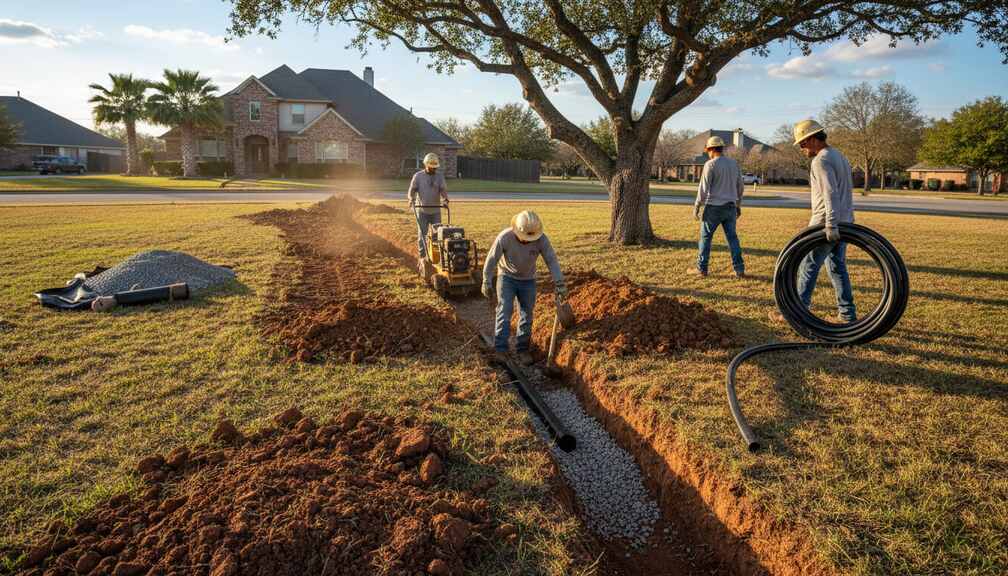
Why Outdoor Drainage Is Not a DIY Project
Outdoor drainage is an engineering problem with multiple interdependent variables, and a mistake in any one of them redirects water toward your foundation instead of away from it. In Austin, where clay soils hold water against foundation walls for days after a storm, a failed DIY drainage attempt can turn a $1,500 professional installation into an $8,000 to $15,000 foundation repair.
What Makes Outdoor Drainage So Difficult to Get Right?
Drainage is a multi-variable engineering problem. The slope of the pipe, the composition of the soil, the pipe size and material, trench depth, and discharge location all have to work together. Get one wrong and the system either fails to move water or redirects it toward your foundation.
In Austin, the difficulty is compounded by geology. The city sits on a fault line between two completely different soil types: Blackland Prairie clay east of I-35 and Edwards Plateau limestone to the west. Add the Austin Watershed Protection Department’s rules on where drainage can legally discharge, and you have a set of local constraints that most online DIY guides were never written to address.
Why Is Proper Slope So Critical for Drainage Systems?
Proper slope is critical because a drainage system that does not maintain a consistent 1% grade minimum, one inch of drop for every eight feet of run, will pool water inside the pipe rather than move it to the discharge point.
When slope is insufficient, water enters the perforated pipe and stops moving. The pipe fills with standing water, saturating the surrounding soil and holding moisture against exactly the structures the system was meant to protect. Standing water inside a buried pipe is invisible from the surface, which means you often don’t realize the system has failed until the damage is already done.
Excessive slope creates the opposite problem. When slope is too steep, water exits the discharge point at high velocity, causing erosion at the outlet and putting stress on pipe joints over time. Achieving consistent slope requires a laser level or transit, not a visual estimate.
Why Pick Sprinkler & Landscape Medics as Your Drainage Contractor in Austin?
We’re an NDS-Certified Contractor, which means every system we design and install is built to manufacturer specifications using the right components for each application — including NDS EZ-Drain, which integrates drainage pipe with a pre-wrapped gravel sock and eliminates one of the most common installation errors. We handle both drainage and irrigation, so we know exactly where your sprinkler lines run before the first trench is opened.
- Veteran-owned and operated, Marine-founded, with veterans on staff
- NDS-Certified Contractor for drainage and water management
- More than 1,000 homes served across the Greater Austin metro
- 4.9-star Google rating with over 147 reviews
- Free installation estimates
We serve homeowners across Travis County and Williamson County, including Cedar Park, Georgetown, Round Rock, Pflugerville, Leander, Hutto, Manor, Liberty Hill, Taylor, and Jarrell.
Common DIY Drainage Mistakes That Make Problems Worse
Industry data shows that 85% of DIY French drains underperform or fail outright. A homeowner spends $500 to $1,500 on materials, the system fails within one or two seasons, and a professional is called in to remove it and install a correct system at a cost of $3,000 to $5,000. A professional installation done right the first time costs $1,500 to $5,000 and lasts 20 to 40 years.
- Using cheap corrugated pipe: The flexible corrugated tubing sold at home improvement stores is not designed for the soil pressure or water volume of a proper drainage system. It collapses under load, clogs with sediment within months, and holds standing water that becomes a mosquito breeding ground beneath the surface.
- Getting the slope wrong: A trench that is even slightly off from the 1% minimum grade will pool water inside the pipe, saturating the surrounding soil rather than moving water away from it.
- Discharging water illegally: Under Austin Watershed Protection Department rules, drainage cannot discharge onto a neighbor’s property or into the street without proper storm easement access. Homeowners who route discharge incorrectly face fines and liability for damage to neighboring properties.
- Ignoring Austin’s clay soil: A trench dug in Blackland Prairie clay without a correctly sloped system and proper pipe fills with water that cannot percolate. The trench becomes a trough that holds water against the foundation rather than moving it away.
- Skipping landscape fabric and gravel bedding: Without proper filter fabric and drainage gravel surrounding the perforated pipe, sediment infiltrates the system and clogs it within the first season, often without any visible surface sign until water is already backing up.
What a Professional Drainage Installation Actually Involves
The process follows a defined sequence:
- System inspection and water flow assessment: Observe and map how water moves across the property, identifying pooling zones, flow paths, and proximity to the foundation
- Soil analysis: Determine clay content, compaction, and permeability
- Property grading evaluation: Use a laser level or transit to establish precise elevation data and determine the correct slope and discharge path
- Drainage system design: Select the appropriate system type based on site-specific water volume and soil conditions
- Material selection: Specify NDS drainage pipe, gravel, landscape fabric, and basin components rated for the specific installation
- Excavation: Trench to the correct depth, locate all utility lines before breaking ground, and protect existing irrigation lines throughout
- Installation: Set pipe at correct slope, connect all components, and wrap in filter fabric with proper gravel bedding
- Integration with gutters and irrigation: Connect gutter downspout extensions and verify the layout does not conflict with existing irrigation zones
- Backfill, grading, and landscape restoration: Restore the yard to grade and reinstall disturbed turf
- Post-installation testing: Run water through the system and confirm the discharge point moves water to the correct outlet
A professionally installed system meets Austin Watershed Protection Department rules, Austin Development Services permit requirements, and TCEQ stormwater discharge regulations. DIY projects frequently violate all three.
How Long Does a Professional Drainage System Last?
| DIY Drainage Fix | Professional Installation | |
| Upfront cost | $500–$1,500 | $1,500–$5,000 |
| Expected lifespan | 1–2 seasons | 20–40 years |
| Rework and removal cost when it fails | $3,000–$5,000 | N/A |
| Foundation damage risk | High (in Austin clay) | Eliminated with proper design |
| Potential foundation repair cost | $8,000–$15,000+ | $0 |
| Insurance coverage for failure | Typically excluded | N/A |
| Code compliance | Often violated | Designed to comply |
Signs Your Yard Needs Professional Drainage Help
Water pooling within 10 feet of your foundation or persisting more than 48 hours after rain: In Austin clay, water held this close to your foundation is already activating the swell-shrink cycle that causes structural damage.
Spongy turf that stays wet for days: Ground that remains saturated long after a storm indicates subsurface water has nowhere to go.
Visible soil erosion or exposed tree roots: Topsoil washing away means water is moving across the surface with enough velocity to strip it.
Water stains, mold, or musty odor in a basement or crawlspace: Surface drainage failure has already become a structural intrusion problem.
Cracks in the foundation: Unresolved drainage will widen those cracks with every storm.
Gutters overflowing or downspouts discharging at the foundation: The single most common cause of residential drainage problems is water from the roof depositing directly at the foundation.
A previous DIY drainage fix that has already failed: A system that failed once will fail again unless the underlying design problem is corrected by a professional.
Can Poor Drainage Cause Foundation Damage in Austin?
Yes. Austin’s Blackland Prairie clay makes this risk higher than in most U.S. cities. The same soil that holds water against your foundation swells when saturated and contracts when dry, applying and releasing lateral pressure on your foundation walls with every weather cycle.
A DIY trench in clay that lacks proper slope becomes a lateral water channel. As it fills, the surrounding clay saturates, swells, and presses against your foundation wall. Instead of solving the drainage problem, the trench creates a new one: a concentrated moisture source sitting directly against the structure it was supposed to protect. Even in a properly graded yard without a functioning drainage system, Austin clay runs this cycle with every rain. The foundation shifts into the gaps left by contracting soil. Over seasons, this accumulation of micro-movements produces the cracks, settling, and structural misalignment that define Austin foundation damage.
Foundation repair in Austin runs $8,000 to $15,000 or more. Most homeowner’s insurance policies exclude foundation damage caused by drainage issues, meaning you carry the full repair cost plus the cost of correcting the drainage situation. Once the foundation has moved, you’re no longer just paying for drainage.
When Should I Call a Drainage Professional Instead of Trying a DIY Fix?
Extending a downspout, clearing a clogged surface grate, or redirecting a single gutter are homeowner-appropriate fixes. Everything else in Austin should be evaluated by a professional before any digging begins.
| Homeowner-Manageable | Requires a Professional |
| Extending a gutter downspout 4–6 feet from the foundation | Standing water within 10 feet of the foundation |
| Clearing debris from a surface drain or catch basin grate | Visible foundation cracks or settling |
| Adjusting a splash block or downspout extender | Soil erosion that has changed yard grade |
| Redirecting a single gutter discharge | A previous DIY drainage fix that has already failed |
| Water intrusion into a basement or crawlspace | |
| Yard that floods with every significant rain event | |
| Any situation requiring trenching |
In Austin’s Blackland Prairie clay, the threshold for calling a professional is lower than in other cities. By the time damage is visible, it has usually been accumulating for seasons.
If you’re seeing standing water, foundation cracks, or soggy turf that won’t dry out, don’t risk a DIY fix that could make it worse. Call Sprinkler & Landscape Medics of Austin today at 512-710-7274 or reach out online to schedule your free consultation.



Leave a Reply
Want to join the discussion?Feel free to contribute!