
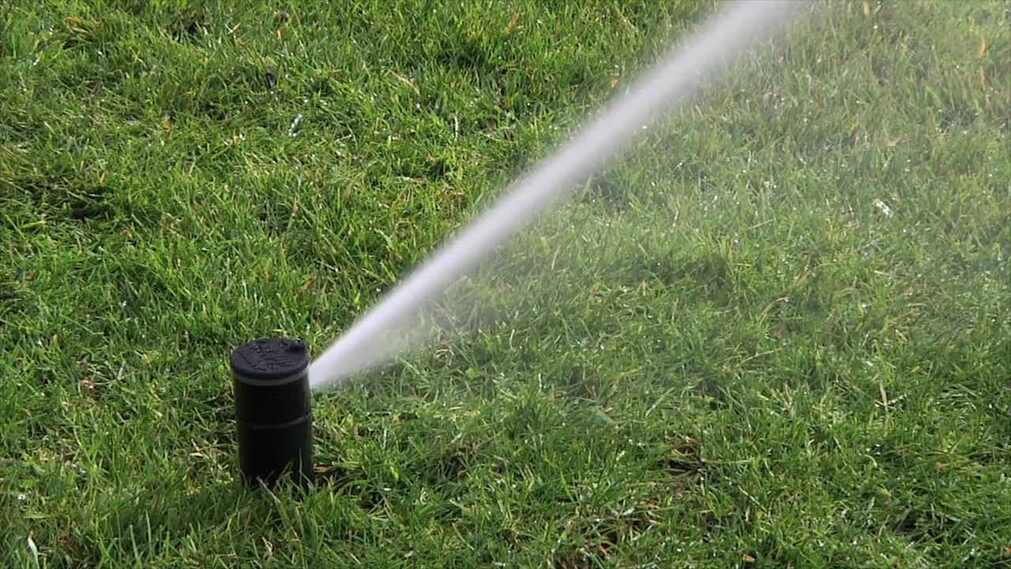
Rotary vs Spray Sprinkler Heads: Which Is Better for Your Lawn
Choosing the wrong sprinkler head for your yard means brown spots that don’t respond to longer run times, runoff pooling at the curb before your cycle finishes, and water wasted on the one day per week Austin Water allows you to run your system. The head type determines how fast water hits the ground, how far it reaches, and whether your soil can actually absorb it before it runs off.
In Central Texas, that last point matters more than most homeowners realize. Austin’s clay-heavy soil absorbs water at roughly 0.2 to 0.5 inches per hour. Spray heads apply water at 1.5 to 2 inches per hour. Rotary nozzles apply water at 0.4 inches per hour. Those numbers explain why two systems with identical run times produce completely different results depending on what’s sitting on top of the pop-up body.
Spray heads, rotors, and rotary nozzles each serve different zone sizes, soil conditions, and coverage needs. The table below shows how they compare across the factors that matter most for Austin lawns.
| Spray Head | Rotor | Rotary Nozzle | |
| Best-Use Area | Small, defined turf, bed edges | Large open turf zones | Mid-size turf, slopes, clay soil zones |
| Typical Radius | 5–15 ft | 25–65 ft | 8–35 ft |
| Precipitation Rate (in/hr) | 1.5–2 in/hr | 0.4–0.8 in/hr | 0.4 in/hr |
| Run Time vs. Spray | Baseline | 2–3x longer | 2–2.5x longer |
| Runoff Risk | Higher on clay or slopes | Lower | Lowest |
| Misting in Wind | Common at high pressure | Less common | Low |
| Austin Suitability Note | Small lots, bed edges, patios | Large turf, suburban lots | Clay soil, slopes, retrofit zones |
| Common Application in Austin | Narrow front strips, planting bed edges | Open back yards, large side yards | Runoff-prone clay zones, sloped turf |
What Are Spray Heads, Rotors, and Rotary Nozzles?
All three head types work on different principles, cover different areas, and suit different yard conditions. Here is what each one actually does.
What Is a Spray Sprinkler Head and Where Does It Work Best?
A spray sprinkler head delivers a fixed, fan-shaped spray pattern that does not rotate, covering areas from roughly 5 to 15 feet in radius depending on the nozzle installed. The nozzle is interchangeable, which means the same pop-up body can accept different coverage arcs, and spray heads apply water at 1.5 to 2 inches per hour — a rate that gets moisture to the root zone fast and keeps your run times short.
Spray heads perform best at 25 to 30 PSI. Above that range, the spray pattern mists rather than throws, reducing coverage and wasting water. Most spray heads use a pop-up body that retracts below grade when not running, though shrub risers are available for raised-bed applications where pop-up height is not sufficient.
If your zone is small, Austin Water’s one-day-per-week schedule works in your favor. Higher application rates mean spray zones reach their target moisture depth faster, which suits restricted watering windows when the irrigated area is small and the water has somewhere to go without running off.
What Is a Rotor Head, and How Is It Different From a Rotary Nozzle?
A gear-driven rotor uses an internal turbine mechanism to rotate a single stream of water back and forth across a wide arc, covering 25 to 65 feet in radius at a precipitation rate of 0.4 to 0.8 inches per hour. Rotors run at 25 to 65 PSI depending on the model, and because the application rate is lower, your rotor zones will need significantly longer run times than spray zones to deliver the same soil moisture depth.
A rotary nozzle is a different product — a multi-stream nozzle insert that mounts on a standard spray body rather than a standalone head. Instead of a single rotating stream, it delivers multiple slow-moving streams that rotate outward from the nozzle, covering 8 to 35 feet at a standard precipitation rate of 0.4 inches per hour. The Hunter MP Rotator is the most widely installed example. The rotor is a standalone head with its own body, drive mechanism, and installation footprint; the rotary nozzle is an insert that drops into the same spray body you already have. If you have an existing spray system, that distinction matters — a rotary nozzle upgrade means no trenching, no pipe work, just a nozzle swap on each head.
Key Differences That Affect Coverage, Runoff, and Run Times
Run time, runoff, and distribution uniformity determine whether your irrigation system waters your lawn or wastes water. In Austin, clay soil absorbs water slowly and summer heat punishes dry zones within days. These variables matter more here than in most other markets — and they should drive how you set up your system.
Why Do Spray Heads Usually Need Shorter Run Times Than Rotors?
Spray heads apply water faster, so they need less time to deliver the same moisture depth to the root zone.
Your spray zones may need 10 to 15 minutes per cycle; your rotor and rotary nozzle zones may need 25 to 40 minutes to deliver the same moisture depth. That ratio holds across most yards, though actual run times vary by plant type, season, and how much water your soil can absorb before runoff begins. Austin Water publishes seasonal watering guidelines at austinwater.org organized by season and plant category — the most locally relevant reference for setting or adjusting your controller.
How Do Precipitation Rates Change Runoff Risk on Slopes or Compacted Soil?
Spray heads apply water faster than your clay soil can absorb it. The excess runs off instead of soaking in. Central Texas clay soil absorbs roughly 0.2 to 0.5 inches per hour under normal conditions. Spray heads apply 1.5 to 2 inches per hour.
The fix is cycle-and-soak programming. Instead of running a zone once for 30 minutes straight, split that into two 15-minute cycles with a 30-minute gap between them. The first cycle wets the soil surface; the gap gives the clay time to absorb that water before the second cycle adds more. This works for spray zones, rotor zones, and any zone on a slope or in an area that shows pooling before the run cycle ends.
Runoff is also a TCEQ compliance issue, not just a water bill problem. Texas Administrative Code Chapter 344 prohibits irrigation water from flowing onto driveways, sidewalks, and streets — and that runoff may put you out of compliance with your system.
What Is Distribution Uniformity and Why Does It Matter for Brown Spots?
Distribution uniformity (DU) measures how evenly water reaches each part of a zone. A low-DU zone delivers too much water in some spots and too little in others — even when your run times look right and the system appears to be working.
Low DU is one of the most common causes of dry patches in Austin irrigation systems. It is frequently misdiagnosed as a run time problem. If you try to fix dry spots by running the zone longer, you end up overwatering the saturated areas while the dry patches barely improve. The cause is usually head spacing, nozzle mismatch, or pressure inconsistency — not run time.
Austin’s summer heat, with triple-digit temperatures common from June through September, makes low-DU zones visually apparent within a single heat wave. Sprinkler & Landscape Medics can identify whether the cause is spacing, pressure, or head type before you spend money replacing heads that weren’t the problem.
How to Choose the Right Head Type for Your Yard
The right head type depends on what your yard is actually asking of the system — zone size, soil behavior, and slope all point toward different answers. Start with the size of the area you need to cover.
Which Sprinkler Head Is a Better Fit for Small or Irregular Lawn Areas?
If your zone is under 15 feet in any dimension, spray heads are your standard choice. The fixed fan-shaped pattern covers those areas precisely, the shorter run time suits tight scheduling windows, and the interchangeable nozzle format lets your installer match the coverage shape to your lot.
For narrow side-yard runs, strips between concrete and planting beds, or zones that run along a fence line, strip nozzles are the right tool. Strip nozzles deliver a narrow rectangular pattern instead of a radial fan — common on Austin bungalow and ranch-style lots where a standard nozzle would hit hardscape on both sides.
Small areas near patios, walkways, or driveways benefit from spray heads for another reason: faster application can be timed to finish before runoff reaches the surface.
Which Sprinkler Head Is a Better Fit for Larger Turf Zones?
If your turf zone exceeds 30 feet in any dimension, rotors are your standard choice. The wider throw radius means fewer heads cover the same area, the lower precipitation rate reduces runoff risk on larger expanses of clay soil, and the longer run time trades against fewer valves and less pipe to maintain.
Fewer heads and valves has a direct cost implication for new installs. To cover a 5,000 square foot back yard with spray heads, you need significantly more heads, valves, and pipe than you would with rotors. On larger lots, that difference shows up meaningfully in the installation estimate.
Newer suburban developments in Round Rock, Cedar Park, Georgetown, and Pflugerville commonly feature larger open turf areas where rotors are the right choice from the start. Many older systems in those areas were installed with spray heads that should be rotor zones — converting them is often more cost-effective than maintaining a spray system undersized for the space.
Do Rotary Nozzles Help Reduce Runoff in Clay Soil?
Rotary nozzles, specifically multi-stream nozzles like the MP Rotator, apply water at 0.4 inches per hour, which falls within the typical infiltration capacity of Central Texas clay soil. That match largely eliminates the runoff problem without requiring cycle-and-soak programming, and it does so using the same spray body already in the ground.
The rotary nozzle insert drops directly onto any standard spray body — no trenching, no pipe work, no valve changes. Swap the nozzle, adjust the run time upward, and your zone performance changes immediately.
Austin’s hard-water supply adds one maintenance requirement specific to this area. Check and clean the inlet filter on your rotary nozzles at least once per season. Hard-water deposits build up in the filter over time, cutting flow and shrinking your coverage radius. In zones with heavier mineral deposits, replace the filter annually.
Design Rules Pros Use to Avoid Dry Spots and Water Waste
The technical principles behind head selection only produce results when the installation follows the design rules that govern how heads are zoned, spaced, and programmed. In Texas, TCEQ-licensed irrigators are required to meet specific design standards on every installation.
Can You Mix Spray Heads and Rotors in the Same Zone?
Mixing spray heads and rotors in the same zone violates matched precipitation rate requirements. Texas irrigation law prohibits it.
When spray heads and rotors share a zone, the spray head area receives 1.5 to 2 inches per hour while the rotor area receives 0.4 to 0.8 inches per hour during the same run cycle. To deliver adequate water to the rotor area, you run the zone long enough for the rotor to cover its territory — but by that point the spray head area has received two to four times its appropriate application. The result is runoff in one section and dry spots in another. No run time adjustment fixes both.
Every Sprinkler & Landscape Medics installation is designed to matched precipitation rate standards under Chapter 344. A properly permitted job will never mix spray heads and rotors on the same zone. If a zone behaves inconsistently no matter how you adjust run times, check for mixed head types first.
What Is “Matched Precipitation Rate” and Why Does Texas Require It?
Matched precipitation rate means all heads in a zone apply water at the same depth per hour, regardless of the arc size or spacing of each individual head. A head covering a 90-degree arc and a head covering a 180-degree arc will not automatically apply water at the same rate just because they are the same model.
Mismatched rates mean some areas get too much water and others too little in the same run cycle. A 90-degree nozzle and a 180-degree nozzle apply water at different rates unless the nozzle is specifically chosen to compensate for the arc. Most standard spray nozzles do not do this automatically. That mismatch produces exactly the kind of brown spots and wet spots you would typically blame on run time rather than design.
Texas Administrative Code Chapter 344 requires matched precipitation rate on all residential irrigation installations. TCEQ uses this standard to evaluate licensed irrigator compliance on every installation.
What Does “Head-to-Head Coverage” Mean in Plain English?
Head-to-head coverage means each head’s spray pattern reaches the base of the next head in every direction, so every point in your zone gets water from at least two heads.
Without head-to-head coverage, the outer edges of each head’s radius receive only a fraction of the water applied closer to the head. The middle of each head’s pattern gets full coverage; the edges between heads get partial coverage from both sides — and the result is a ring of dry turf that persists no matter how long the zone runs. Homeowners who add run time to fix dry edges end up overwatering the center of each head’s pattern. The dry rings stay.
Improper head spacing is one of the most common problems Sprinkler & Landscape Medics finds on Austin system inspections, particularly in systems installed before TCEQ codified current spacing standards. If your yard has a repeating pattern of dry spots that appear roughly equidistant from each other and from the heads around them, head spacing is the likely cause.
FAQs About Rotary vs Spray Heads for Austin Lawns
How Long Should I Run Spray Heads vs Rotors in Austin?
Plan on 10 to 15 minutes per cycle for spray zones and 25 to 40 minutes for rotor and rotary nozzle zones. The difference traces directly to precipitation rate. Neither figure is fixed — season, plant type, and soil condition all shift the numbers.
Austin Water’s seasonal watering guidelines at austinwater.org are your most reliable local starting point for setting or adjusting your controller run times.
For clay soil zones showing pooling before the run cycle ends, split your rotor run time into two shorter cycles with a 30-minute gap between them.
If your spray heads show runoff or misting, upgrading to rotary nozzles is often the most practical fix.
Are Multi-Stream Rotary Nozzles a Good Upgrade From Traditional Sprays?
Rotary nozzle upgrades are a practical option for Austin spray zones showing runoff, dry spots, or pressure misting — the nozzle fits directly onto your existing spray body without any pipe work. Pull the old spray nozzle off the pop-up, thread the rotary nozzle on, and your zone goes from applying 1.5 to 2 inches per hour down to 0.4. For zones on clay soil or slight slopes, that rate change alone often eliminates the runoff problem.
After upgrading to rotary nozzles, increase your controller run times by approximately 2 to 2.5 times to deliver the same soil moisture depth. If your spray zone ran for 12 minutes, plan on 25 to 30 minutes after the rotary nozzle swap. Skipping that adjustment is the most common mistake after a rotary nozzle upgrade and leaves turf under-watered.
Before You Switch Heads
- Check static water pressure at the valve box. Rotary nozzles perform well at 40 PSI; spray heads operate at 25 to 30 PSI. If pressure falls significantly outside these ranges, a pressure regulator may be needed before switching.
- Confirm that existing head spacing matches the coverage radius of the new nozzle type. Rotary nozzles have a wider radius than most spray heads, and spacing that worked for spray heads may leave gaps with rotary nozzles.
- Identify zone type. Rotary nozzles can share a zone with other rotary nozzles but cannot be mixed with standard sprays or rotors in the same zone without violating matched precipitation rate requirements.
- Locate the inlet filter slot on the new rotary nozzle and confirm a fine-mesh filter is included. Austin’s hard-water supply requires a functional filter to prevent mineral buildup in the nozzle mechanism.
Get the Right Heads on Your Austin Irrigation System
Choosing between spray heads, rotors, and rotary nozzles comes down to zone size, soil behavior, and slope. In Central Texas, where clay soil absorbs water slowly and Austin Water gives you one assigned day per week to work with, the wrong head type on the wrong zone costs you that entire window every time your system runs.
If your yard has persistent dry spots, runoff pooling at the curb, or zones that mist instead of throw, the problem is more likely head selection or spacing than run time. Adding minutes to a poorly matched zone does not fix the underlying issue.
Sprinkler & Landscape Medics of Austin is a TCEQ-licensed, veteran-owned irrigation company serving Greater Austin, Cedar Park, Round Rock, Georgetown, Pflugerville, and the surrounding area. Ready for reliable irrigation service from a veteran-owned team you can trust? Reach out to Sprinkler & Landscape Medics of Austin today for a free estimate.



Leave a Reply
Want to join the discussion?Feel free to contribute!