
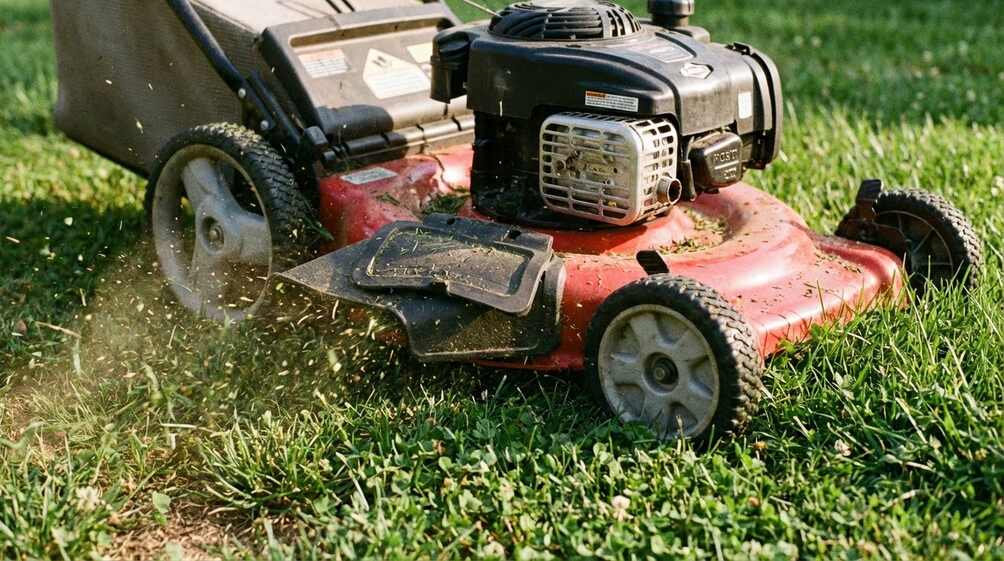
How Mowing Height Affects Watering Needs in Austin
How tall you cut your grass directly determines how much water your lawn needs, and in Austin, where automatic irrigation is limited to one day per week, getting it wrong shows fast. Taller grass blades shade the soil surface, slow evaporation, and encourage roots to grow deeper where moisture stays available longer between waterings. Staying at the right height consistently is one of the easiest ways to keep your lawn healthy on one watering day a week.
The Connection Between Mowing Height and Water Needs
Austin’s summers routinely exceed 100°F, and that heat accelerates evapotranspiration (the combined loss of water through soil evaporation and plant transpiration) at a rate that closely mowed lawns simply can’t keep up with. Under Austin Water’s one-day-per-week automatic irrigation restriction, if your lawn dries out two days after watering, it spends five days under heat stress with no legal path to relief. Mowing height is one of the few things you control that directly extends how long your lawn stays hydrated after each watering session.
Taller grass also develops a more extensive root system. University of Missouri Extension research (G6720) found that lawns mowed at 3–3.5 inches survive prolonged drought significantly better, because more root depth means more access to subsurface moisture.
Why Sprinkler & Landscape Medics is Your Austin Irrigation and Lawn Care Partner
Mowing at the right height works best when your irrigation system is calibrated to match the root depth you’re building. A taller lawn with deeper roots needs water delivered deeper, less frequently, and timed to match your soil’s actual moisture-holding capacity. Together, they produce a lawn that stays green on one watering day a week.
We are a veteran-owned, Marine-founded irrigation and landscaping company serving Central Texas. Our team is NDS-certified in drainage contracting, meaning our recommendations account for how water actually moves through Austin’s clay and limestone soils. We’ve worked on more than 1,000 Central Texas lawns, and our 4.9-star rating across 147+ Google reviews consistently points to professionalism and honest pricing. A portion of every service goes back into the Austin community. We serve Austin, Cedar Park, Round Rock, Georgetown, Pflugerville, Leander, Hutto, Liberty Hill, Manor, Taylor, and Jarrell.
Our seasonal irrigation membership plans keep your system tuned through Austin’s seasonal shifts, so your mowing habits and irrigation schedule stay aligned.
Ideal Mowing Heights for Austin’s Most Common Warm-Season Grasses
Here are the right heights for Austin’s most common warm-season grasses and how each affects your watering needs.
| Grass Type | Recommended Range | Summer Height | Watering Impact |
| St. Augustine (Raleigh, Palmetto) | 2.5–4 inches | 3–3.5 inches | Maximum soil shading; reduces evaporation significantly |
| Bermuda (Tifway 419, Common) | 1–2.5 inches | 1.5–2.5 inches | Dense canopy at proper height; severe stress if cut below 1 inch |
| Zoysia (Palisades, Zeon) | 1.5–2.5 inches | 1.5–2 inches | Dense, efficient canopy; holds moisture well once established |
| Buffalograss | 3–4 inches (managed) | 3–4 inches | Native drought tolerance; lowest irrigation demand of the four |
The One-Third Rule and Why It Matters for Irrigation
Never remove more than one-third of the grass blade’s total length in a single mowing session. Violating it stresses your grass in ways that directly increase irrigation demand.
When you remove more than one-third of the blade in one cut, your grass goes into recovery mode. The root system pays the price. Your grass pulls energy away from root development and redirects it toward regrowing the blades it just lost. Roots stop growing deeper and stay shallow, close to the surface where your grass is spending its recovery energy. Your lawn shows drought stress earlier in the week, and under Austin’s one-day restriction, you can’t simply water again. The result is a lawn that’s permanently more dependent on irrigation than it needs to be, not because of the grass type or the weather, but because of a mowing habit you can fix at no cost.
Here’s what that pattern costs in practical terms:
- Shallow roots dry out faster between waterings, reducing the interval your irrigation system can cover.
- Grass under constant recovery stress demands more frequent irrigation to maintain the appearance of health.
- Damaged blade tips lose moisture faster than cleanly cut grass, accelerating surface-level evaporation.
- A weakened root system becomes more vulnerable to Austin’s summer heat with each repeated violation.
Most warm-season grasses grow fast enough during May through September to require weekly mowing. Skipping a week typically means you can’t return to target height without removing more than one-third of the blade.
A sharp blade cuts cleanly through the grass tissue; a dull blade tears it. Sharpen your blades at least once mid-season. It takes 20 minutes and directly reduces how much water your lawn loses between sessions.
How Mowing Height Works With Austin’s Water Restrictions
You’re limited to one watering day per week, and mowing at the right height is one of the most effective ways to make it last. Mowing at the right height costs nothing and works with Austin’s restrictions, not around them.
Austin Water’s Conservation Stage restrictions limit automatic irrigation to one designated day per week, with sessions allowed only between midnight and 10 a.m. or between 7 p.m. and midnight.
When you cut your grass at the right height, the blades form a canopy over the soil surface. Deeper roots mean your lawn stays green longer after each watering than a closely cut lawn in the same conditions. Here’s how to put that into practice:
- Adjust your mowing height by season: Raise your cutting height in summer, when heat stress and evaporation are at their peak, and lower it slightly in spring and fall when temperatures ease and root stress decreases.
- Mulch clippings back onto the lawn: Returning clippings adds organic matter and retains surface moisture, reducing how much extra water your lawn needs between sessions.
- Water deeply on your designated day: One thorough watering that saturates the root zone does more than multiple shallow sessions, and keeps you within Austin’s one-day limit while actually reaching the depth where deeper roots live.
Common Mowing Mistakes That Increase Watering Needs
A full grass canopy and deep roots are what keep your lawn green on a restricted watering schedule. These five habits quietly work against both.
- Protect your canopy; don’t scalp. Cutting too short removes your canopy, exposes the soil to direct summer sun, and puts your grass into a recovery cycle that drains energy from root development for days. In Austin’s heat, your lawn can show visible stress within 24 hours of scalping and stays stressed until the canopy grows back.
- Mow weekly to keep roots growing deeper. Infrequent mowing followed by heavy removal is the most common way you violate the one-third rule without realizing it. Skipping a week during Austin’s May through September growing season typically means your grass has grown past the point where you can return to target height without removing more than one-third of the blade. That repeated cycle keeps root systems shallow and irrigation demand elevated throughout the summer.
- Clean cuts seal faster and lose less moisture. Dull mower blades tear grass tissue rather than cutting it cleanly. Torn tissue dries out faster at each cut surface. A sharp blade eliminates that extra moisture loss entirely.
- Mowing in the early morning or evening preserves moisture in your freshly cut blades. If you mow during peak heat hours, roughly 10 a.m. to 6 p.m., your freshly cut blades lose moisture faster. Mow in the early morning or evening so cut tissue can seal before the heat of the day peaks.
- Mulching returns moisture and nutrients to your soil. When you mulch instead of bag, clippings decompose quickly on the soil surface, adding organic matter and retaining surface moisture between sessions. Switch to mulch mode through the summer months. We offer mulching as part of our lawn care services.
If you’re weighing a switch to St, Augustine or Zoysia, or if your irrigation system is working harder than it should to keep up, we can help with both.
Ready for reliable irrigation service from a veteran-owned team you can trust? Call Sprinkler & Landscape Medics of Austin today at 512-710-7274 or reach out online to schedule your free consultation.



Leave a Reply
Want to join the discussion?Feel free to contribute!