
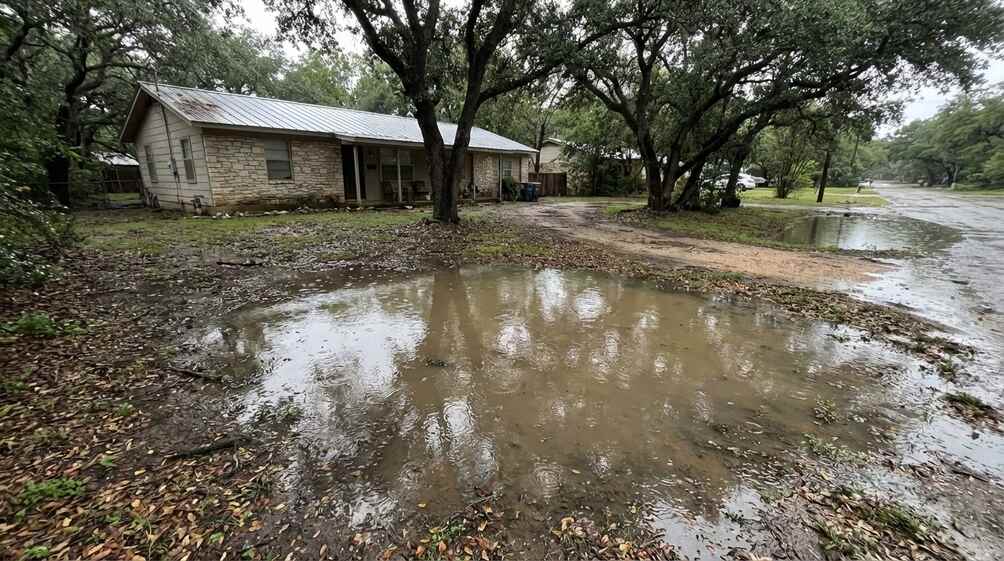
How to Identify Yard Drainage Issues After a Storm
If your yard isn’t draining after a storm, here’s what to look for. Austin’s Blackland Prairie clay soil east of I-35 and the rocky Edwards Plateau limestone terrain to the west create conditions that turn a hard rain into a drainage problem fast. If these signs keep showing up after every storm, call us — we’ll tell you exactly what’s causing it.
What to Look for in Your Yard After a Storm
Here’s what to look for when you walk your property after the storm.
- Standing Water and Puddles: If water pools in the same low spots after every storm, your soil can’t absorb or drain it fast enough. It creates conditions for mosquito breeding and can saturate root zones to the point of causing root rot in nearby plants and turf.
- Soggy or Spongy Turf: If your lawn feels soft and waterlogged underfoot well after the rain has stopped, the soil below is holding more moisture than it should. Waterlogged soil squeezes oxygen out of your root zone, stressing your turf and leaving it vulnerable to fungal disease.
- Soil Erosion and Gullies: If you see channels or gullies forming in your lawn after heavy rain, water is moving too fast across the surface and taking your soil with it. That erosion reshapes your yard’s grade and can expose root systems and irrigation lines.
- Water Pooling Near the Foundation: Water collecting against your foundation is the most urgent sign on this list. Hydrostatic pressure from saturated soil pushes against foundation walls and can cause cracking and settling. A French drain is one of the most effective ways to redirect that water before it reaches your foundation.
- Gutter Overflow and Downspout Problems: If your gutters are spilling over during a moderate rain or your downspouts are discharging directly against the foundation, the problem isn’t just the gutters. Without proper extensions or drainage to move water away from the house, it pools against your foundation.
- Foul Odors and Mosquitoes: If your yard pools consistently after rain, you’re creating a prime mosquito breeding environment. If you’re noticing both standing water and foul odors, the water isn’t draining within a healthy timeframe.
- Dying or Yellowing Plants: If your plants or turf are yellowing in areas that stay wet after rain, that’s often early-stage root rot. Check whether the affected areas are the same spots where water pools after rain.
Water should drain from your yard within 24 to 48 hours after a storm. If it’s still sitting after that window, you have a drainage problem.
Why Pick Sprinkler & Landscape Medics as Your Drainage Solution Partner in Austin
- Veteran-Owned: We’re a veteran-owned company, and we bring the same attention to detail and follow-through to your drainage project that military service demands. We diagnose before we recommend, and we don’t cut corners on installation.
- Giving Back: A portion of every job goes back into the Austin community, because taking care of this city means more than just solving drainage problems.
- NDS Certified: Our team holds NDS certification in drainage system design, installation, and maintenance. That means we’ve been trained to properly design and install drainage systems according to established engineering and performance standards, not just dig a trench and lay pipe. For a homeowner hiring a drainage contractor, it’s the clearest sign the person knows what they’re doing — and it’s especially relevant in Austin, where clay soil, limestone terrain, and flash flood conditions create drainage challenges that generic installation experience isn’t equipped to handle.
- 9 Stars on Google: We hold a 4.9-star rating on Google. Homeowners across Austin consistently tell us we delivered exactly what they needed.
- Free Estimates: We offer free estimates so you know exactly what the problem is and what it costs to fix before any work begins.
When you’re ready, call us at 512-710-7274.
Why Austin Yards Are Especially Prone to Drainage Problems
Austin’s drainage challenges come directly from the region’s geology and climate.
To the west of I-35, Austin sits on the Edwards Plateau, a limestone-dominated terrain with thin, rocky soil and very low water retention. When rain falls on the plateau, it moves quickly across the surface because the underlying rock doesn’t absorb it. That runoff concentrates in low points and pools on flat lots without a drainage system in place.
East of I-35, the geology shifts to the Blackland Prairie, where the defining feature is expansive clay soil. Blackland Prairie clay swells when saturated and shrinks and cracks as it dries. During a storm, that clay absorbs water slowly and resists drainage, creating waterlogged, pooling conditions.
Austin also sits within what the Lower Colorado River Authority identifies as Flash Flood Alley. Storm systems here can dump several inches in a matter of hours. That kind of intensity exposes every flaw in your yard’s drainage fast.
The City of Austin Watershed Protection Department manages more than 1,100 miles of storm drain infrastructure across the city, much of it built for lower-density neighborhoods than what exists today. As Austin has grown and impervious cover has expanded, older systems are handling runoff volumes far beyond what their designers intended.
Common Causes of Yard Drainage Problems in Austin
Beyond geology and infrastructure, most drainage problems on individual Austin properties trace back to one or more specific on-site conditions.
- Improper Yard Grading: Your yard should drop at least an inch per foot moving away from your foundation. When grading is flat, reversed, or settled unevenly, water moves toward the foundation instead of away from it. This is common in older properties where soil has settled and the original slope has flattened or reversed.
- Compacted Soil: Foot traffic, heavy equipment, and years of vehicle parking compact clay soil until it can barely absorb water. The soil becomes so compacted it can’t absorb even moderate rainfall, producing surface pooling. Mulching protects soil from erosion, reduces surface compaction, and helps retain moisture in the root zone.
- Clogged or Undersized Gutters and Downspouts: Roof runoff deposited against your foundation is one of the most damaging things a gutter system can do. When gutters back up or downspouts discharge against the foundation, water pools against your foundation. This is one of the most common contributors to foundation-adjacent pooling after rain in Austin.
- Missing or Failing Drainage Systems: Many Austin properties simply don’t have any designed drainage system in place. Others have French drains or catch basins that have failed due to root intrusion, sediment buildup, or pipe collapse. Either way, water has nowhere to go.
- Hardscape Changes: When you add hardscape without a drainage plan, that runoff ends up against your foundation or pooling in adjacent lawn areas. Patios, driveways, and walkways replace permeable ground with surfaces that shed runoff entirely, and without a drainage plan that water has to go somewhere.
- Disconnected or Damaged Drain Pipes: Pipes that have separated, cracked from root intrusion, or collapsed from soil movement can look fine from the surface but be completely failed underground. Water entering a damaged drain either discharges in the wrong place or backs up entirely.
Drainage Solutions That Work for Austin Properties
- French Drains: We install a perforated pipe in a gravel trench that collects subsurface water and redirects it away from problem areas. French drains are particularly effective for foundation-adjacent pooling and yards with persistent saturation in low-lying areas. For clay-heavy soils, combining a French drain with yard regrading gives you the most complete fix — the drain intercepts subsurface water before the clay saturates, and regrading controls where surface runoff goes before it has a chance to pool.
- Yard Regrading: When the root cause is a flat or reverse-graded yard, regrading the soil to restore proper slope is the most direct fix. This involves moving soil to re-establish a grade that consistently directs sheet flow away from your house and toward appropriate discharge points.
- Channel and Trench Drains: These surface drainage systems intercept sheet flow along driveways, patios, and walkways before it reaches the foundation or accumulates in adjacent lawn areas. They’re a practical solution anywhere water concentrates along a hardscape edge during a storm.
- Dry Creek Beds: A dry creek bed manages surface runoff through a designed channel lined with river rock or gravel that guides water to a discharge point while adding a natural aesthetic element to the landscape. This works well where water has a visible path that just needs to be guided to a discharge point.
- Downspout Extensions: When gutters are functioning but downspouts are discharging too close to the foundation, extending them to move water further into the yard or connecting them to an underground drainage line is often all that’s needed. It’s inexpensive and frequently overlooked.
- Catch Basins: A catch basin is a surface-level inlet that collects water from a low point in your yard and routes it underground to a safe discharge point away from your home. It’s the right fix when one persistent low spot keeps pooling and regrading hasn’t solved it.
- Aeration and Soil Amendment: Core aeration and compost topdressing improve your soil’s ability to absorb water over time. Combine it with sod installation to repair storm-damaged turf once drainage is corrected.
| Solution | Ideal Use Case | Estimated Cost Range |
| French Drain | Subsurface water saturation, foundation-adjacent pooling | $$$ |
| Yard Regrading | Flat or reverse-graded yards, water flowing toward house | $$$ |
| Channel / Trench Drain | Surface sheet flow along driveways, patios, walkways | $ – $$ |
| Dry Creek Bed | Aesthetic solution for surface runoff channels | $ – $$ |
| Downspout Extension | Water discharging close to foundation | $ |
| Catch Basin | Low-point surface water collection | $ – $$ |
| Aeration + Soil Amendment | Compacted clay-heavy soil with poor infiltration | $ |
Frequently Asked Questions About Yard Drainage After a Storm
Can Yard Drainage Problems Damage My Foundation?
Yes. Water that consistently pools near your foundation creates hydrostatic pressure against foundation walls, which can cause cracking, settling, and structural movement. Foundation repairs in Texas range from approximately $5,000 to $30,000 or more depending on severity.
How Much Does It Cost to Fix Drainage Problems in a Yard?
The honest answer is it depends on the problem. A downspout extension or simple catch basin sits at the lower end of the range, while a full French drain system or yard regrading is a more substantial investment. Call us for a free estimate and we’ll give you a real number.
What Is a French Drain and Do I Need One?
A French drain is a subsurface drainage system made up of a perforated pipe set in a gravel trench that collects groundwater and redirects it away from problem areas. When we install your French drain, we design it for your specific soil conditions and drainage load. You likely need one if soil near your foundation stays saturated after rain, or if a section of your yard takes days to dry out after a storm.
How Do I Know if My Yard Needs Regrading?
Walk your yard after a heavy rain and watch where water goes. If it moves toward the house rather than away from it, your grade is either insufficient or reversed in that area. If the rain was too light to tell, we can survey your grade and give you a definitive answer.
Protect Your Austin Property With a Professional Drainage Assessment
Every storm that moves through Austin is a stress test for your yard, your foundation, and your landscaping investment. Recurring drainage problems only get more expensive to ignore. We bring NDS certification, veteran-owned values, and free estimates to every project, from a single catch basin installation to a complete French drain and regrading system. We’ve served more than 1,000 homes across Austin, Georgetown, Cedar Park, Round Rock, Pflugerville, Leander, Manor, Hutto, Liberty Hill, Taylor, and Jarrell.
Ready for reliable drainage service from a veteran-owned team you can trust? Call Sprinkler & Landscape Medics of Austin today at 512-710-7274 or reach out online to schedule your free consultation.



Leave a Reply
Want to join the discussion?Feel free to contribute!