
What is drainage service and does your lawn need it?
Standing water that lingers in your yard after rain is more than an inconvenience. In Austin, where clay-heavy soil absorbs water slowly and summer storms can drop several inches in an hour, persistent pooling puts your foundation at risk, creates mosquito breeding conditions, and can cause erosion damage that gets worse with every rain event.
Drainage problems in Central Texas yards come from a few common sources: poor lot grading, soil that has settled since the home was built, runoff concentrating from adjacent hardscape or neighboring properties, and in some cases, an irrigation schedule that is overwatering the lawn. Before investing in a drainage system, it helps to understand what type of problem you are dealing with and which solution actually fits your site.
At Sprinkler & Landscape Medics of Austin, we install French drains, catch basins, and drainage solutions across Greater Austin, Cedar Park, Round Rock, Georgetown, Pflugerville, and surrounding communities. We are a licensed, insured, veteran-owned company that offers free estimates and designs every drainage plan around your specific yard conditions and local stormwater requirements.
What Drainage Service Is and What It Typically Includes
A good contractor starts with a site evaluation before proposing any installation, so the solution is designed for your specific site. In Austin and across Central Texas, clay-heavy soil and intense summer rain events are the conditions that most often require drainage work. The City of Austin Watershed Protection Department provides guidance on managing residential runoff. Make sure your drainage plan accounts for local stormwater requirements from the start.
What Is the Difference Between Surface Drainage and Subsurface Drainage?
Surface drainage moves water across the ground to a designated outlet using slope, channels, swales, or surface drains. Subsurface drainage collects water below ground through perforated pipe and gravel systems, like a French drain, and carries it away before it can saturate the soil above. Clay soil holds water rather than letting it percolate downward. That means subsurface solutions are often necessary even when the only visible symptom is surface pooling. Your yard may need a combination of both.
Signs Your Lawn May Need Drainage Service
The most recognizable signs include standing water, spongy turf, erosion channels, foundation pooling, and washed-out mulch. Central Texas clay soil holds water significantly longer than sandy or loam soils, so symptoms that appear minor after a light rain can signal a larger problem once a heavier storm hits. If you’re in a newer Austin neighborhood, your lot may be especially prone to this. Fill soil settles over time and creates low spots that weren’t there when your home was graded. Drainage problems can also show up in your planting beds, along fence lines, and near your downspout discharge points, so walk the full perimeter of your yard when you check after rain.
How Long Should Water Stand in a Yard Before It Becomes a Problem?
As a general rule, standing water that hasn’t cleared within 24 to 48 hours after rain is worth investigating. Clay soils percolate slowly by nature, so some surface water immediately after a heavy Central Texas storm is expected. The question is whether it clears within 24 to 48 hours. If you see standing water after a watering cycle rather than a rain event, your irrigation schedule may be the problem, not your drainage. Austin Water assigns watering days based on your street address and limits automatic irrigation to one day per week. If you’re running your system more frequently than your schedule allows, you may be oversaturating soil that would drain fine under a correct schedule.
Here are the most common signs to watch for:
- Standing water that lingers more than 24 to 48 hours after rain: water that clears within a day is often normal for clay soil; water that persists points to a slope or capacity problem
- Spongy or saturated turf: soil that feels soft and wet underfoot long after rain suggests poor percolation or a low spot collecting runoff from surrounding areas
- Erosion channels or washed-out mulch: visible channels in soil or displaced mulch after rain indicate surface water is moving too fast and concentrating in specific paths
- Water pooling near your foundation: water pooling against your foundation needs attention sooner than most drainage problems, as persistent moisture can cause long-term structural issues
- Mosquito activity in standing water: puddles in Central Texas heat become mosquito breeding grounds fast
- Washed-out beds or soil displacement along fence lines: these often indicate runoff from adjacent hardscape or neighboring lots is concentrating in your yard
Common Drainage Solutions for Austin Yards
The right solution depends on where water is entering your yard, where it needs to go, and what your soil and slope conditions allow. French drains, catch basins, and regrading each solve a different problem, and many Austin yards need more than one.
What Is a French Drain and How Does It Work?
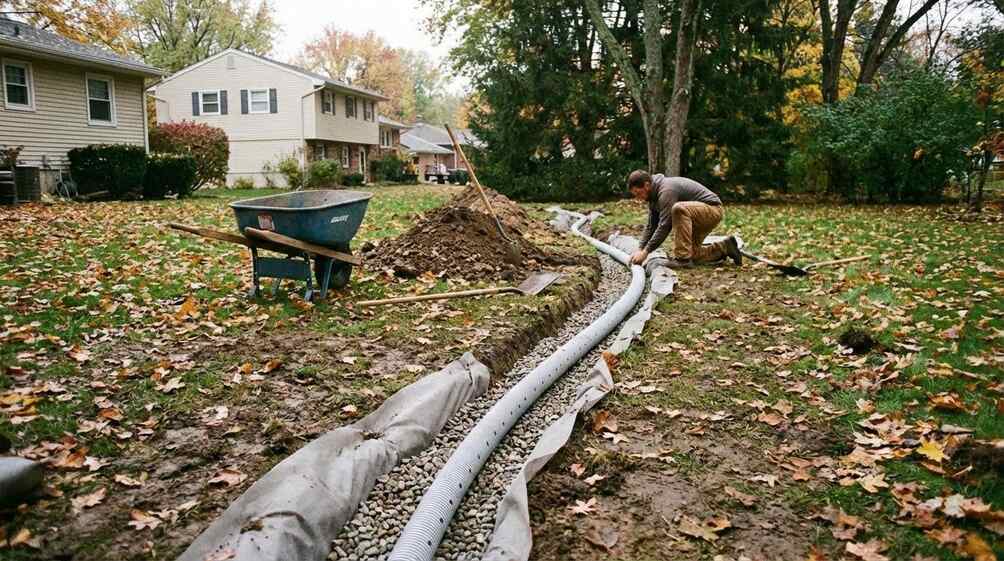
A French drain uses a gravel-filled trench and perforated pipe to collect subsurface water and redirect it away before it saturates your soil. Two things determine whether a French drain will work: adequate slope for water to move through the pipe, and a clear outlet path for water to exit. You need more careful filter fabric selection and outlet placement here than you would in areas with sandier soil. An improperly designed French drain in clay can become saturated and stop working. Work with a contractor who knows Central Texas soil. Sprinkler & Landscape Medics installs French drains across Greater Austin and can assess whether your yard’s slope and outlet options make a French drain the right call.
What Is a Catch Basin and When Is It the Right Choice?
A catch basin is an underground collection box with a grated surface inlet. When water pools on the surface, it flows through the grate into the box, and an outlet pipe carries it away. A catch basin is typically the better choice when water is pooling on the surface at a patio edge, along a driveway, or in a low spot in the turf. It targets concentrated surface water more precisely than a French drain, which is designed for subsurface saturation. In Austin yards, catch basins are commonly installed where runoff from driveways, patios, or roof downspouts collects in a low spot. Your contractor needs to plan the outlet carefully because City of Austin stormwater rules govern where that water can go.
When Does Regrading Solve Drainage Issues Better Than Drains?
When water is pooling because your yard slopes toward your house or toward a low spot, correcting the grade may redirect water away without any underground installation. Many Austin-area lots were graded correctly when they were built but have settled or eroded since, particularly on lots built over compacted fill-soil conditions. Only an on-site evaluation can tell you whether regrading is enough or whether you also need a drain, because clay-soil compaction or subsurface saturation may also be a factor. Sprinkler & Landscape Medics offers landscaping services alongside drainage work, so regrading and drainage installation can be handled in a single project.
| Solution | Best Use Case | Strength | Common Failure Mode | Austin Consideration |
| French drain | Subsurface water saturation, soggy turf | Moves water below ground over a wide area | Clogs if filter fabric is wrong for clay soil; fails without adequate slope | Filter fabric selection and outlet placement are critical in clay-heavy soils |
| Catch basin | Surface pooling from runoff, low spots near hardscape | Captures concentrated surface water efficiently | Outlet pipe undersized or poorly sloped; grate clogs with debris | Common near driveways, patios, and downspout discharge points in Austin neighborhoods |
| Regrading | Water pooling because yard slopes toward house or a low spot | May eliminate need for a drain entirely | Temporary if underlying soil compaction or fill settlement continues | Common first step in new-build Austin lots where original grade has settled |
| Channel / surface drain | Water sheeting across hardscape or paved areas | Captures fast-moving surface water along a linear path | Improper slope; outlet connects to street without city approval | Outlet planning must account for City of Austin stormwater rules |
What to Expect From a Drainage Evaluation and Installation
How Do Pros Diagnose Drainage Problems in Central Texas Clay Soil?
In clay-heavy soils like those common across Travis County and Williamson County, water moves laterally across the soil surface rather than percolating straight down. That means drain placement needs to account for where water is traveling, not just where it is pooling. A professional site evaluation typically involves observing where water enters, pools, and exits; assessing existing slope and grade; identifying outlet paths; and noting soil type, compaction, and any fill soil that may be contributing to the problem. Sprinkler & Landscape Medics has worked across Austin-area neighborhoods long enough to recognize the patterns that show up specifically in this region’s soil and topography.
How Do Watering Rules Affect Drainage and Irrigation Scheduling in Austin?
Before scheduling a drainage evaluation, check whether standing water or soggy turf appears after irrigation cycles as well as after rain. Overwatering can produce symptoms that look just like a drainage problem. Austin Water assigns watering days based on your street address. Automatic irrigation is typically limited to one day per week. If you’re running your system more frequently than your schedule allows, you may be oversaturating soil that would drain normally under a correct schedule. A professional evaluation can tell you whether the problem is drainage or irrigation scheduling. Correcting the schedule is a much simpler and less expensive fix than installing a drainage system.
Who to Hire for Drainage Work in Austin
For drainage work connected to an irrigation system, look for a contractor licensed under TCEQ’s landscape irrigation program. Texas regulates irrigation work, and you can verify licensing through the TCEQ website. Ask your contractor to explain the outlet plan before work begins. A drainage system without a clearly identified, code-compliant outlet path is a common source of failed installations. Ask your contractor to document the drainage plan, including slope grades and outlet location, before installation starts.
Before Your Drainage Evaluation
- Walk your yard within one to two hours of a significant rain event and note where water is pooling or sheeting
- Check your downspout discharge points and note whether water from the roof is spreading away from your foundation or pooling against it
- Identify any visible erosion channels or areas where soil or mulch has been displaced
- Note whether water is standing on turf, in beds, near hardscape edges, or in multiple locations
- Return 24 to 48 hours later and note which areas have cleared and which still show standing water or saturated soil
- Check whether soggy areas correspond to irrigation zones and note whether symptoms appear after watering cycles rather than rain
FAQs About Yard Drainage
Do French Drains Work in Austin Clay Soil?
Yes, French drains can work effectively in Austin clay soil, but design matters more here than in areas with sandier or loamier soil. Two factors determine whether the system will hold up over time in Central Texas: filter fabric selection, which prevents clay particles from migrating into the gravel and clogging the pipe, and outlet placement, because clay’s slow percolation rate means the drain must have a clear, adequately sloped path to move water efficiently. Installing a French drain without proper fabric or outlet planning is one of the most common reasons drainage systems underperform in Central Texas. If you’re considering a French drain installation in the Austin area, Sprinkler & Landscape Medics can assess your site and design a system built for local soil conditions.
Where Does the Water Go After a French Drain or Catch Basin?
A French drain or catch basin collects water and directs it through a pipe to a designated outlet. That outlet may be a street curb opening, a drainage easement, a dry creek bed, or a connection to a municipal storm drain, depending on what is available and permitted in your yard. Outlet options vary significantly by lot configuration and proximity to drainage easements. Not every yard has a straightforward discharge point, which is one of the primary reasons a site evaluation is necessary before installation. Any outlet that directs water toward streets or neighboring yards may require review under City of Austin Watershed Protection guidelines.
Schedule a Free Drainage Evaluation in Austin
Persistent standing water in a Central Texas yard does not resolve on its own. Whether the cause is clay soil that cannot drain fast enough, a lot that has settled since it was graded, or runoff concentrating from a neighboring property, the problem gets worse with every heavy rain event. The right solution depends on where the water is coming from and where it has a clear path to go.
Before any installation begins, a site evaluation will tell you whether you need a French drain, a catch basin, regrading, or a corrected irrigation schedule. That last option costs nothing to fix and is worth ruling out first.
Sprinkler & Landscape Medics of Austin is a licensed, insured, veteran-owned company installing drainage solutions across Greater Austin, Cedar Park, Round Rock, Georgetown, Pflugerville, and the surrounding area. Ready for reliable drainage service from a veteran-owned team you can trust? Reach out to Sprinkler & Landscape Medics of Austin today for a free estimate.



Leave a Reply
Want to join the discussion?Feel free to contribute!